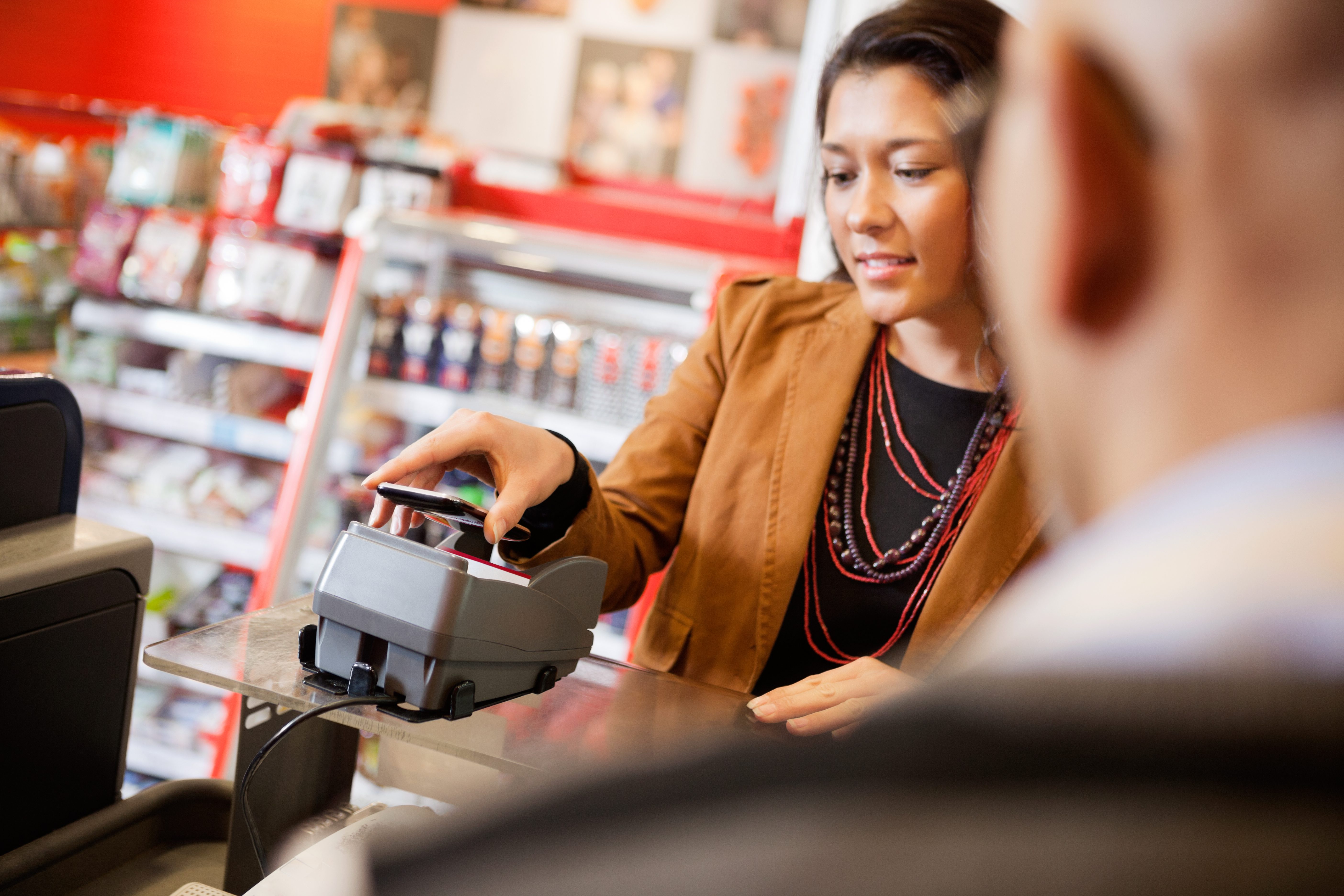
‘Mobile payments’ is a broad term. As the ecosystem has developed, various new technologies have emerged to change the way we act and transact in-store.
Integrating new with the old
Some mobile payment technologies are focused on seamlessly connecting the mobile device to the existing payments infrastructure.
NFC leading the way
After an uncertain start, NFC has emerged as a leading proximity payment technology. The advent of host card emulation (HCE) significantly reduced the complexity for banks and retailers deploying NFC payment solutions, enabling users to make standardized EMV® contactless transactions with their mobile device. The position of NFC within the ecosystem was then cemented by the launch of the various OEM Pay platforms, which all use the technology.
As the OEM Pay platforms and mobile wallets solutions mature, NFC mobile payments are here for the long-run, supported by the wider proliferation of NFC-enabled smartphones and an expanding EMV contactless infrastructure. A key future growth trend is the significant increase in the deployment and adoption of wearable payment solutions.
Return of the QR Code
The most impressive growth across mobile proximity payments, however, has been QR Codes. To date, this has been largely driven by China. QR Code-based payment platforms AliPay and WeChat Pay have emerged as cultural phenomena, accounting for close to $5.5 trillion in transactions in 2016 and essentially rendering cash obsolete in urbanized areas.
The success of QR Codes is not just limited to Asia, though. Indeed, the largest retail mobile payment platforms worldwide are united in their use of optical scanning technology such as QR Codes and barcodes, including Walmart and Starbucks.
Retailers across the globe are therefore moving to leverage the simplicity and flexibility afforded by QR Codes at the point-of-sale. And with EMVCo introducing dedicated QR Code specifications in 2017 to promote global interoperability and enhance security, deployments are set to accelerate.
Creating new buying experiences
Importantly, the power of mobile payments lies not only in simplifying existing payment processes, but in enabling new, enhanced, seamless buying experiences.
Simple in-aisle payments
Nobody likes waiting in line. For retailers, removing friction at the checkout is central to enhancing the overall customer experience. Mobile wallets incorporating scan-and-go technology enable consumers to easily scan their items as they shop, and then checkout in-aisle with a simple in-app purchase.
This removes the need for a traditional, static point-of-sale, reducing checkout lines and freeing up valuable real estate.
Enabling invisible payments with Bluetooth Low Energy (BLE)
A step beyond in-aisle payments are ‘invisible payments’, which require no conscious interaction between the consumer and the retailer.
The technology integrations required to enable truly invisible payments are highly complex, and there is significant innovation in this space as various schemes and pilots explore different approaches. BLE beacons are essential for enabling in-store invisible payments, as they allow retailers to monitor a consumer’s activity in-store by communicating with their connected devices. As retailers continue to drive payments innovation, BLE is likely to have a significant role to play.
Tokenization – unifying mobile payments security
Regardless of the payment method deployed, tokenization technology is an essential element to enable secure mobile transactions. Payment tokenization replaces a customer’s primary account number (PAN) with a unique payment token that is restricted in its usage, for example, to a specific device, merchant, transaction type or channel. This means tokenization can help to secure in-store transactions made via mobile wallets across various differing payment technologies, whether it be NFC, QR Codes or BLE. It also reduces the risk and impact of card-on-file fraud using stored credentials, enhancing the security of in-app and in-aisle payments.
As mobile payment technologies emerge and evolve, the way we pay in-store is set for unprecedented change. The promotion of safe, secure experiences is key to establishing consumer confidence and driving the adoption of new payment methods. The role of tokenization, therefore, is poised for significant expansion across the mobile payments ecosystem.