PaymentsJournal
No Result
View All Result
SIGN UP
  • Commercial
  • Credit
  • Debit
  • Digital Assets & Crypto
  • Digital Banking
  • Emerging Payments
  • Fraud & Security
  • Merchant
  • Prepaid
PaymentsJournal
  • Commercial
  • Credit
  • Debit
  • Digital Assets & Crypto
  • Digital Banking
  • Emerging Payments
  • Fraud & Security
  • Merchant
  • Prepaid
No Result
View All Result
PaymentsJournal
No Result
View All Result

Apple Pay Growth Hints at the Future of Digital Wallets

By Pete Reville
February 12, 2020
in Analysts Coverage, Digital Banking, Emerging Payments
0
11
SHARES
0
VIEWS
Share on FacebookShare on TwitterShare on LinkedIn
Branch Launches Mobile Wallet Capabilities to Provide Immediate Debit Card Access

Branch Launches Mobile Wallet Capabilities to Provide Immediate Debit Card Access

As an avid Apple Pay user, I read with interest a recent Quartz article on the worldwide growth of this digital wallet. According to the article, Apple Pay is on pace to account for 10% of all global card transactions; Apple Pay currently accounts for 5% of global card transactions and that number will double by 2025.

While it may not seem like Apple Pay will monopolize card transactions any time soon, 5% is a big number considering the number of players in the space and many ways to pay. In the last three months of 2019, Apple’s service unit Apple Pay created $12.7 billion in revenue, which is a 17% increase from the same period a year earlier.

How does Apple make money from Apple Pay card transactions? Apple makes its money by taking a little piece of the transaction fee applied to every card transaction.  Given the number of card transactions that happen every day, this “little” piece they take clearly adds up to some real revenue for Apple.

Our PaymentsInsights data shows growth of the use of universal wallets like Apple Pay and Chase Pay as more consumers get used to the idea of a mobile wallet and, equally important, the increase in merchant acceptance.
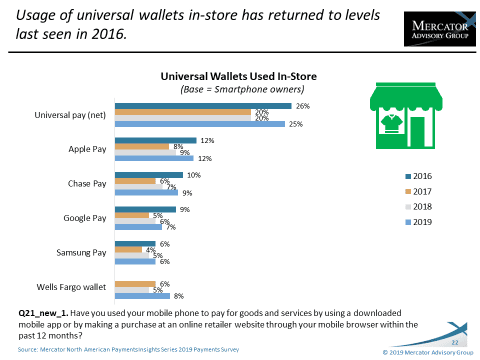
As the article points out, Apple has clear advantages over some of its universal wallet competitors:

There’s no shortage of slick, feature-rich payment apps out there, but Apple Pay has several advantages. The app is pre-installed on iPhones, and Apple has tight control over the device’s NFC technology that’s used for contactless payments. That’s why Apple Pay is the only iPhone mobile wallet that can make NFC transactions. (Alipay and WeChat Pay, the enormously popular Chinese payment apps, use QR-codes. The optical codes are read through a phone’s camera and aren’t controlled by Apple.)

Alas, there are some potential hiccups along the way to payments domination.  First of all, Android phones are the dominant market leader globally – and I don’t think you’ll see Apple Pay on an Android phone any time soon, for obvious reasons.

Further, the article does highlight some of the regulatory issues that Apple is up against in the EU as regulators have shown concerns about Apple playing nice with the competition. We will have to see where that all nets out.

Digital universal wallets are here to stay. What was once a nice to have feature is starting to become mainstream. Some will argue that it’s about time since Apple Pay launched in 2014.

Card payments have a lot of moving parts. In order to get transactions to run through a phone, the system needs help from the payment networks, issuing and acquiring banks, POS manufacturers and, most importantly, consumers.  Given all this, it’s a wonder we’ve gotten this far.

Overview by Peter Reville, Director, Primary Research Services at Mercator Advisory Group

11
SHARES
0
VIEWS
Share on FacebookShare on TwitterShare on LinkedIn
Tags: Apple PayCustomer ExperienceDigital TransactionsDigital WalletsMobile Wallets

    Get the Latest News and Insights Delivered Daily

    Subscribe to the PaymentsJournal Newsletter for exclusive insight and data from Javelin Strategy & Research analysts and industry professionals.

    Must Reads

    chatgpt payments

    How Merchants Should Navigate the Rise of Agentic AI

    January 30, 2026
    fraud passkey

    Why the Future of Financial Fraud Prevention Is Passwordless

    January 29, 2026
    payments AI

    When Can Payments Trust AI?

    January 28, 2026
    Contactless Payment Acceptance Multiplies for Merchants: cashless payment, Disputed Transactions and Fraud, Merchant Bill of Rights

    How Merchants Can Tap Into Support from the World’s Largest Payments Ecosystem

    January 27, 2026
    digital banking

    Digital Transformation and the Challenge of Differentiation for FIs

    January 26, 2026
    real-time payments merchant

    Banks Without Invoicing Services Are Missing a Small Business Opportunity

    January 23, 2026
    card program

    Should Banks Compete in the Credit Builder Card Market?

    January 22, 2026
    real-time payments, instant payments

    Getting Out in Front of Instant Payments—Before It’s Too Late

    January 21, 2026

    Linkedin-in X-twitter
    • Commercial
    • Credit
    • Debit
    • Digital Assets & Crypto
    • Digital Banking
    • Commercial
    • Credit
    • Debit
    • Digital Assets & Crypto
    • Digital Banking
    • Emerging Payments
    • Fraud & Security
    • Merchant
    • Prepaid
    • Emerging Payments
    • Fraud & Security
    • Merchant
    • Prepaid
    • About Us
    • Advertise With Us
    • Sign Up for Our Newsletter
    • About Us
    • Advertise With Us
    • Sign Up for Our Newsletter

    ©2024 PaymentsJournal.com |  Terms of Use | Privacy Policy

    • Commercial Payments
    • Credit
    • Debit
    • Digital Assets & Crypto
    • Emerging Payments
    • Fraud & Security
    • Merchant
    • Prepaid
    No Result
    View All Result