Increased security and simplicity granted a high demand for P2P payments. With the rapid development of e-commerce and online services, P2P payment app development is a profitable idea. In this post, you’ll figure out the main steps of P2P payment app development, security issues, and basic features that should be developed primarily.
Why should you build a P2P payment app?
There are several types of payment apps, and each of them is good for different purposes. Let’s single out each type.
- Banking services. Some banks offer P2P apps that make payments faster and easier. However, merchants that use P2P services should have PoS terminals that accept these payments.
- Discrete Services. This type of service can keep users’ funds on their accounts if they don’t want to withdraw the money right away. PayPal and Venmo are the most outstanding examples of discrete P2P services. They allow users to make payments via Visa and MasterCard.
- Mobile OS Systems. Google Pay and Apple Pay are P2P payment services that allow users to send money to other users with the same operating system. Besides, this software allows users to pay via NFC in shops equipped with up-to-date PoS terminals.
Primary features for P2P payment app
To satisfy user needs, your payment system should have some basic P2P payment features. Let’s take a closer look at each of them.
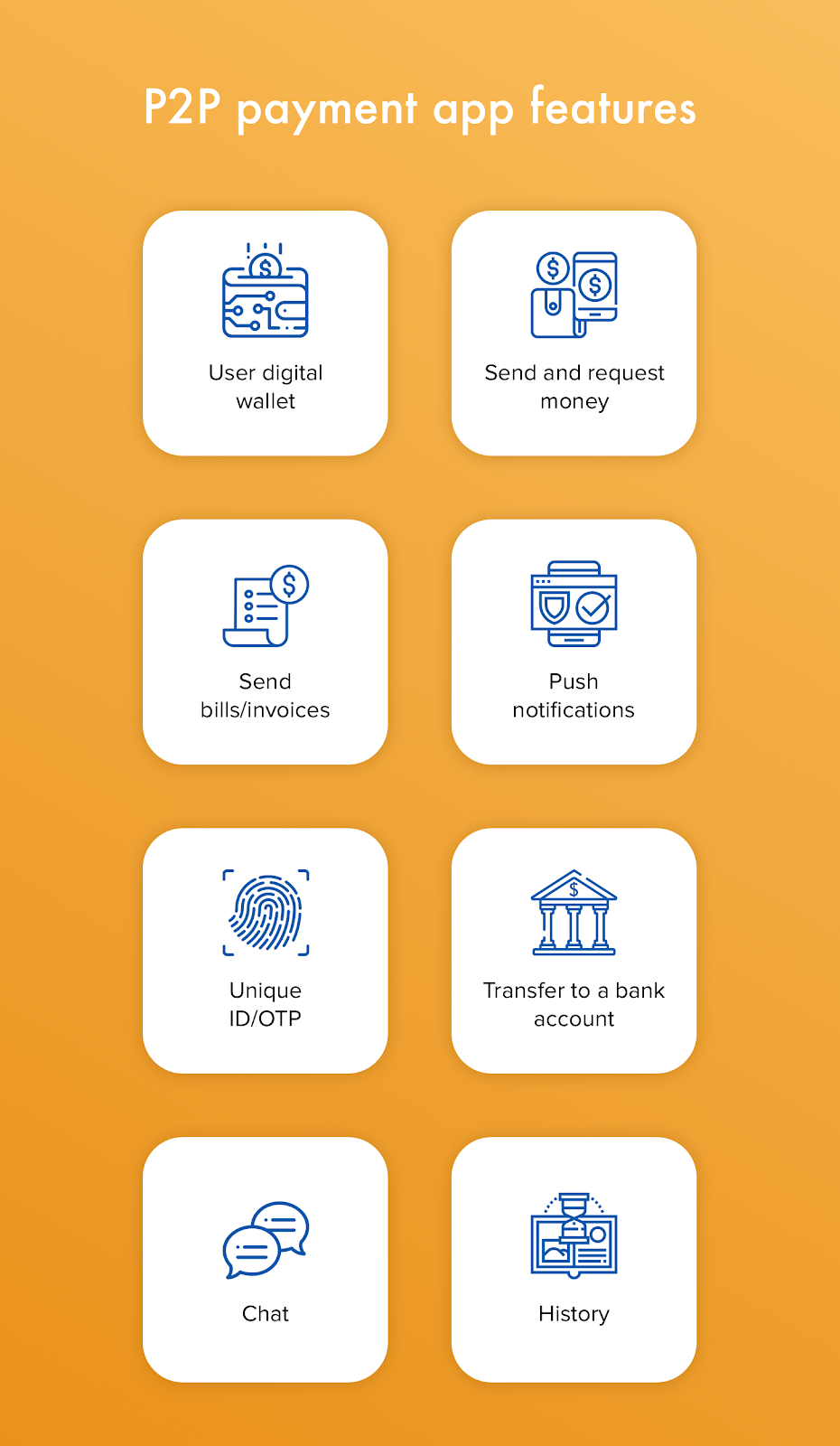
Digital wallet
Here, users will keep their money, add credit card data, monitor previous transactions, and more. It’s the main feature that involves all other features listed below.
Performing transactions
Users should be able to transfer money from their wallet to another. In case you’re going to work with business, you can add a request feature. Thus, a user will be able to request a payment from another party and wait for it to be approved.
Send invoices
Make sure that users are able to make an in-app scan of the invoice and send it to other users. Later on, you can develop a feature that generates invoices and submits them.
Push notifications
Push notifications keep users updated about the transactions and remind them of dates to pay bills. You can also use notification for marketing purposes, like offering a discount.
Bank account transfers
Users should be able to send their money to their bank accounts or credit cards with the P2P system.
Chat
A chat may come in handy to clarify payment details with a receiver. Besides, in case of technical issues, customers will contact technical support via the text chat.
Admin Panel
With the management panel’s help, admins will track payments, reclaim unsuccessful transactions, manage users, and more.
Essential steps in P2P app development
As we’re clear with basic features, it’s time to find out what are the main steps in P2P app development.
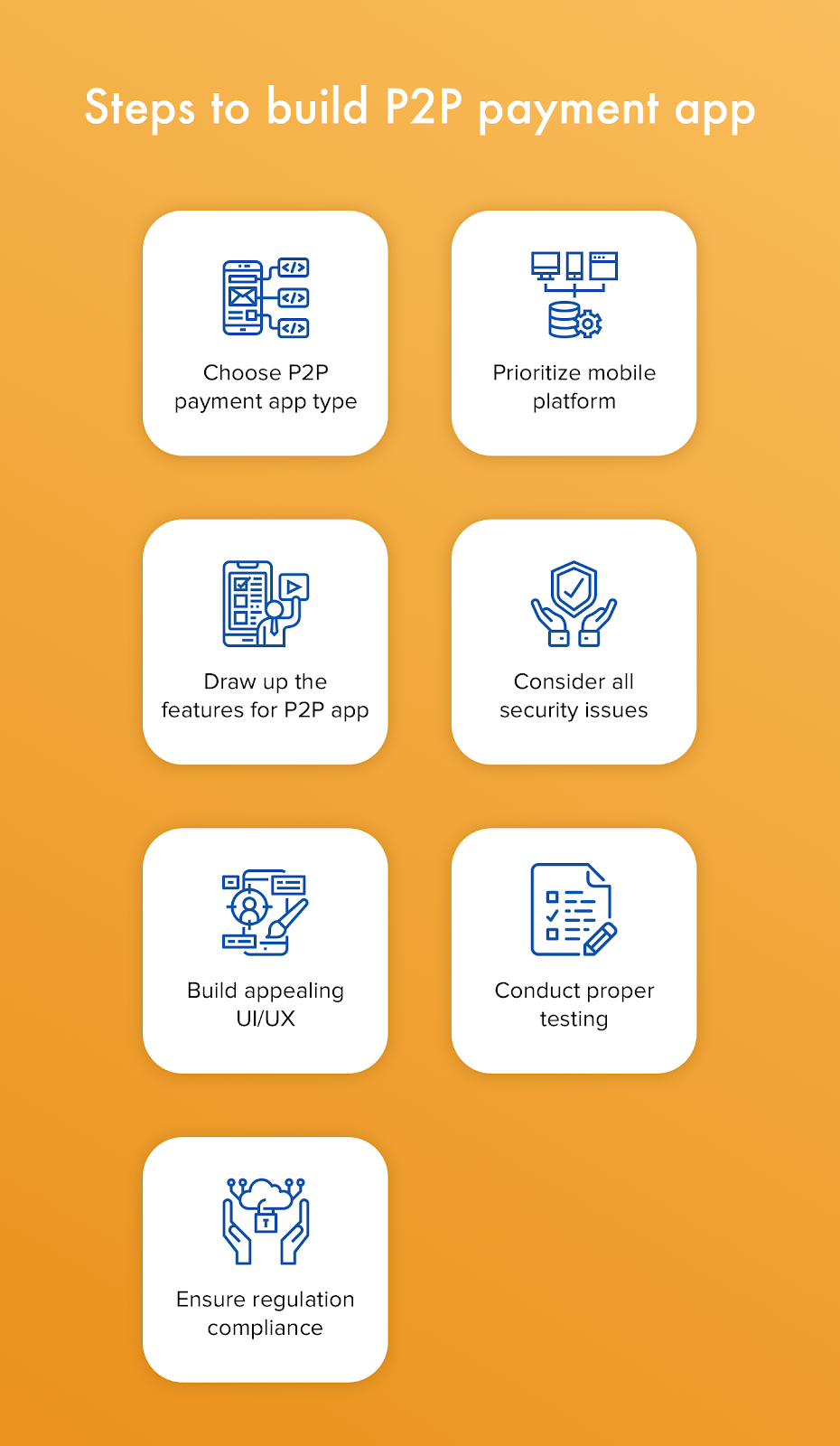
Decide on the payment app type
First things first, choose a type of your P2P payment system. Choose between banking and discreet services according to your business needs.
Decide on a platform
If you’re on a budget, it’s better to start with a single platform. Conduct market research to find out what platform suits you the most. Then, when your app brings profit, you can aim at another platform.
Come up with a feature list
Apart from features from the previous section, your app should have something that will make it stand out among the rivals. Come up with unique functionality that no other app can offer.
Take care of security issues
This step is crucial because you’re dealing with your customers’ payment details. Thus, your app should be reliable and well-protected.
To ensure privacy and keep away intruders from user accounts, you have to add security features. Fingerprints, face recognition, and other security technologies can be applied to improve safety. On top of that, develop a two-step verification. Send a message to the user’s phone or email to verify their identity.
To avoid large fines and provide top-notch security, your app should be PCI DSS compliant. It has 12 strict requirements that describe different aspects of payment software protection.
UI/UX Design
As with any software, the P2P payment app should have an attractive and intuitive user interface. Don’t make your users waste time figuring out how things work. Simplify interactions with the app and make the design minimalistic. But remember that a practical and good-looking design will significantly increase app development cost.
Quality assessment
Make sure to hire experienced QA engineers, because bugs and vulnerabilities aren’t acceptable in P2P payment apps. It’s a great idea to conduct alpha and beta testing of your app. Gather a group of enthusiasts that will test your software at initial stages and report about every detected bug.
Wrapping up
To sum up, P2P payment apps are gaining momentum and have a promising future. With a well-built software and proper means of marketing, you can win over a large audience and gain large revenue. However, to comply with all security regulations and deliver superior performance, you have to find an experienced team of developers.