

Stablecoins are faster, cheaper, transparent and always-on—making them a top-flight payment option across nearly every use case. Hundreds of billions of dollars of payments volume is set to be optimized using these rails in the coming years.
To capture this promise, a flood of stablecoin infrastructure firms have emerged to build solutions, but this has only caused fragmentation. Choosing the right partners has been a sticking point, as payments companies struggle to find signal in the noise. Go with the more “universal” solutions, and you must contend with their weaknesses and geographic limitations. Go with the more “specialized” platforms, and you embark on a never-ending journey of connecting and integrating the parts.
As financial services companies have explored stablecoin services, they have discovered that they must cobble together a hodgepodge of vendors to manage critical functions like orchestration, compliance, settlement, and foreign exchange. With each of these integrations comes costs and complexities which can quickly mount as operations scale.
All these issues can be largely attributed to a single factor—stablecoin infrastructure emerged from the cryptocurrency model and was never built to underpin the volume and use cases that payments companies facilitate.
“There are a million stablecoin companies,” said Pat Duffy, Co-Founder of Cyclops. “Many do some things well. None are great at everything. Cyclops exists to solve this problem. We integrate the best platforms at every layer of the stack, across the world and provide it to payments platforms through a single API.”
Building for the Maturing Market
Despite the gaps in the existing infrastructure, stablecoins are an inevitability. Last year, stablecoin supply jumped 72% year-over-year to nearly $300 billion, according to research by Artemis.
There are several factors fueling this growth, but none more critical than regulatory clarity. For decades after its inception, the digital asset industry languished in uncertainty. While consumers and early adopters eagerly embraced the technology and innovated, larger established players—especially highly regulated financial institutions—stayed on the sidelines to see how regulation played out.
The passage of landmark digital assets legislations such as the GENIUS act in the U.S. and the Markets in Crypto-Assets (MiCA) rules in Europe have changed this perspective, and given organizations a blueprint for organizational stablecoin implementations.
This regulatory certainty has spurred another accelerant for stablecoin adoption: institutional investment. Most of the largest financial services firms—and even big tech and retail companies—have significantly invested in digital assets in some form in recent years. This includes internal investments in technologies like blockchain, but also blockbuster acquisitions like Mastercard’s BVNK deal and Stripe’s purchase of Bridge.
Along with clearer regulation and substantial investment, another key driver for stablecoin adoption is its sheer utility. The digital assets provide a night-and-day upgrade over many existing payment models, most notably over the correspondent banking model in cross-border payments.
Compared to the delays, fees, foreign exchange complexities, and regulatory quagmires which are often associated with sending payments internationally, stablecoins offer a compelling alternative, as they can settle in seconds with low fees and full transparency.
All these factors are fueling a dynamic stablecoin upswing. In this zeitgeist, it has become critical for financial institutions to map out and deploy effective stablecoin strategies.
Unfortunately, many payments firms hit roadblocks as they explore widescale implementation. One of the main obstacles is that stablecoins were never built to handle the nuances of conventional payments.
“The blockchain transaction itself might cost pennies, but that doesn’t mean the payment costs pennies,” said Joel Hugentobler, Cryptocurrency Analyst at Javelin Strategy & Research. “Once you layer in compliance, FX, reconciliation, and other integrations as needed, infrastructure fragmentation becomes a real part of the payment economics.”
A Patchwork of Vendors
To facilitate all these aspects of stablecoin operations, hundreds of organizations and solutions have emerged.
The most visible of these organizations are stablecoin issuers. This includes market leaders like Tether and Circle, whose USD-backed products dominate the market. There are also firms which facilitate issuance for institutions. For example, Paxos issues the Pax Dollar stablecoin, but it also provides the infrastructure for PayPal’s branded stablecoin, PYUSD.
Other companies have emerged to provide wallet and custody options that are suited for enterprise use. Still others handle conversions between fiat currencies and stablecoins, and some platforms focus on currency conversions in cross-border settlements.
While each of these vendors may provide valuable services, managing this growing group of partners can rapidly escalate complexity and costs.
Stablecoin Payments at Scale
The compounding complexity of stitching together multiple stablecoin vendors.

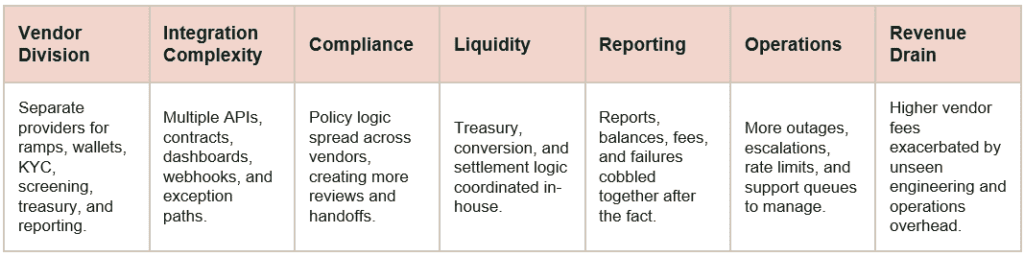
The selection process alone can drain valuable time—something that is in short supply at many organizations—as institutions must evaluate vendors’ capabilities, negotiate terms, ensure compliance obligations are met, and integrate technical systems. This is to say nothing of the continuous management these relationships require, both to monitor performance and ensure alignment with treasury, legal, operations, and product teams.
This compounding complexity is why many companies have chosen the path of least resistance—moving forward with the partners they believe can cover the widest range of use cases.
Unfortunately, this approach often does not significantly mitigate vendor costs and complexity, and it can even create a separate pain point. Overreliance on a small group of vendors can cause institutions to miss out on the chance to optimize pricing, identify new opportunities, and evolve their systems appropriately.
The Next Phase of Adoption
All these issues are driving the need for an overarching solution which can reduce the spiraling number of vendor integrations.
Not only could this dramatically reduce operational complexity and lower maintenance costs, but it could also reduce the burden on merchant customers. For example, the solution could enable a business to scale into a new market more effectively or add further digital assets support—without rebuilding infrastructure.
Ideally, the platform would enable merchants to receive funds far faster than traditional banking rails allow. Stablecoins offer 24/7 settlement, and platforms should allow merchants to access liquidity on weekends and holidays in every region.
While the efficiency of stablecoins is often viewed as their key feature, what most differentiates them from other digital assets is their lack of volatility. When backed by a stable fiat currency, stablecoins can give users safe harbor from the fluctuations which often plague cryptocurrencies, and many fiat currencies.
This means that an ideal stablecoin solution should give users the capability to consolidate funds into their preferred currencies—which allows them to mitigate foreign exchange volatility and manage treasury operations more accurately.
Another critical aspect is payout support. Payouts have become an important use case for stablecoins as more companies rely on gig workers, freelancers, creators, contractors, and marketplace participants to power their business models.
While many of these workers are in different regions, they all expect fast, flexible access to the funds they have earned, regardless of the local currency or regulations. This is another use case where stablecoins excel.
The global footprint of many businesses requires this same efficiency to extend to cross-border payments and remittances. This necessitates a platform with broad geographic reach and the capability to facilitate transactions across markets with few intermediaries.
Along with this reach, the platform should eliminate chargeback risk for stablecoin transactions, something both merchants and consumers have come to expect in every payment type.
On top of all these considerations, a unifying stablecoin solution must provide robust global licensing and compliance support. This includes Know Your Customer, anti-money laundering, reporting, and licensing requirements. Given that stablecoin regulation is still nascent in many areas, any solution must also be agile enough to adapt to changes.
While there are a host of considerations, resolving fragmentation has become critical for the continued evolution of the digital economy.
“The next phase of stablecoin adoption is less about giving financial institutions access to another blockchain and more about removing the complexities of using and integrating one,” Hugentobler said.
Moving Beyond Crypto
While this is a difficult task, the benefits of digital assets have made stablecoin integration imperative for financial services companies to remain competitive. Stablecoins can substantially improve global money movement—and banks’ positioning as the central financial services hub— but only if they are supported by the proper infrastructure.
Solutions like those offered by Cyclops can provide an all-in-one API for payments, payouts, settlement, treasury, and compliance workflows. This allows stablecoins to finally move beyond their generic crypto infrastructure limitations and realize their full payments potential.
“The long-term opportunity isn’t to force payment companies to use stablecoins,” Hugentobler said. “It’s to make stablecoins a viable and easy-to-use solution that a provider can use when offering payment solutions. Stablecoins were born in crypto, but at the end of the day, they won’t scale in payments if payment companies have to operate like a crypto company to use them.”