
PaymentsJournal
No Result
View All Result
SIGN UP
  • Commercial
  • Credit
  • Debit
  • Digital Assets & Crypto
  • Digital Banking
  • Emerging Payments
  • Fraud & Security
  • Merchant
  • Prepaid
PaymentsJournal
  • Commercial
  • Credit
  • Debit
  • Digital Assets & Crypto
  • Digital Banking
  • Emerging Payments
  • Fraud & Security
  • Merchant
  • Prepaid
No Result
View All Result
PaymentsJournal
No Result
View All Result

The Difference between a Smart Contract and a Smart Legal Contract Explained

By Tim Sloane
September 24, 2021
in Analysts Coverage, Blockchain, Digital Assets & Crypto
0
0
SHARES
0
VIEWS
Share on FacebookShare on TwitterShare on LinkedIn
The Difference between a Smart Contract and a Smart Legal Contract Explained

The Difference between a Smart Contract and a Smart Legal Contract Explained

If interested in learning about smart contracts, not from a technologist, but from a lawyer that understands technology, this article in The National Law Review is for you! 

It opens with simple examples of what a smart contract is and what it does (I enjoyed the vending machine example).  Things get more interesting as smart contracts are evaluated based on existing Uniform Commercial Codes.  This is where the rubber starts to meet the road. 

The article also evaluates smart contracts versus smart legal contracts, which is obviously an important distinction, and categorizes common vulnerabilities smart contracts might exhibit. This article is well worth your time if trying to better understand contracts implemented in software (and references are available in the article):

“In addition, for the smart contract to constitute a legally binding contract for the sale of goods, the contract must also satisfy the various requirements of Article 2 of the Uniform Commercial Code (UCC),  including its statute of frauds requirements and its requirement that the contract set forth a quantity in order to be enforceable.5  Practitioners will need to evaluate on a case-by-case basis whether a smart contract meets these elements and therefore represents a binding legal contract for the sale of goods.

The Uniform Law Commission and the American Law Institute established a Uniform Commercial Code and Emerging Technologies Committee6 to study and evaluate the UCC in the context of “among other issues, distributed ledger technology, virtual currency, electronic notes and drafts, other digital assets, payments, and bundled transactions,” and the Uniform Law Commission released an issues memorandum7 discussing these topics in July 2021 following two years of committee meetings.  While smart contracts have been part of the discussion, no formal evaluation for smart contracts has been performed by the Uniform Law Commission or the American Law Institute, leaving open the opportunity for clearer guardrails in the future as to whether a smart contract amounts to a legal contract.

Smart Contracts vs. Smart Legal Contracts

Smart contracts are not to be confused with smart legal contracts.  While a smart contract is a computer program coded to effectuate an outcome upon the occurrence of a triggering event, a smart legal contract is “a legally binding agreement that is digital and able to connect its terms and the performance of its obligations to external sources of data and software systems.”8  The Accord Project makes clear that, although a smart legal contract can use smart contracts via blockchain technology, a smart legal contract can also be created using traditional software systems without the use of blockchain.9”
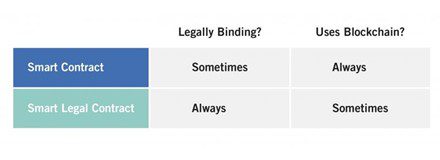
Photo Credit: The National Law Review.

Overview by Tim Sloane, VP, Payments Innovation at Mercator Advisory Group

0
SHARES
0
VIEWS
Share on FacebookShare on TwitterShare on LinkedIn
Tags: BlockchainLegislationSmart ContractsSmart Legal Contract

    Get the Latest News and Insights Delivered Daily

    Subscribe to the PaymentsJournal Newsletter for exclusive insight and data from Javelin Strategy & Research analysts and industry professionals.

    Must Reads

    first-party-fraud

    Returns, Disputes, and the Rise of First-Party Fraud

    March 4, 2026
    commercial payments

    From Theory to Application: The Impending Transformation of Commercial Payments

    March 3, 2026
    Payments Modernization, ACH payments

    ACH and the Path Toward Future-Ready Payments

    March 2, 2026
    millennial gen z business owner

    Gen Z and Millennials Are Business Owners: Are Banks Ready?

    February 27, 2026
    google blockchain

    Why Banks Should Follow Fintechs’ Lead on Developer Portals

    February 26, 2026
    credit unions

    Not Just Another Bank: How Credit Unions Can Reach Younger Members

    February 25, 2026
    fraud

    Escalating Scams Demand a Dedicated Response

    February 24, 2026
    metal credit card

    Why More Global Consumers Are Aspiring to Unbox Metal Cards

    February 23, 2026

    Linkedin-in X-twitter
    • Commercial
    • Credit
    • Debit
    • Digital Assets & Crypto
    • Digital Banking
    • Commercial
    • Credit
    • Debit
    • Digital Assets & Crypto
    • Digital Banking
    • Emerging Payments
    • Fraud & Security
    • Merchant
    • Prepaid
    • Emerging Payments
    • Fraud & Security
    • Merchant
    • Prepaid
    • About Us
    • Advertise With Us
    • Sign Up for Our Newsletter
    • About Us
    • Advertise With Us
    • Sign Up for Our Newsletter

    ©2024 PaymentsJournal.com |  Terms of Use | Privacy Policy

    • Commercial Payments
    • Credit
    • Debit
    • Digital Assets & Crypto
    • Emerging Payments
    • Fraud & Security
    • Merchant
    • Prepaid
    No Result
    View All Result