

Tracing the Origins of Card Payments
Card payments are on a path of tremendous growth: in 2022, global card networks processed a whopping 624 billion transactions, marking a growth of 7.5% compared to 2021. Today, payment cards reign supreme as the preferred method for in-store purchases worldwide, accounting for over 50% of all transactions, and cash is starting to disappear in certain parts of the world.
The backdrop for this transformation takes us back to the challenging days of the Great Depression in the 1930s. Faced with economic hardship, enterprising U.S. merchants devised a solution by extending credit to customers through store-cards and charge plates, where a single card operated exclusively within one department store or a specific gas station chain.
The Birth of Payment Schemes
Fast forward to 1950 in New York, where businessman Frank McNamara’s forgetfulness led to a pivotal moment. Left without his wallet during a restaurant dinner, McNamara’s wife drove into town and settled the bill. This incident sparked the idea of creating a way to pay with a card at eateries, giving birth to the Diners Club credit card. Unlike its predecessors, this card offered credit at multiple merchants. In 1958, American Express followed suit, launching its inaugural credit card.
These early credit cards were not backed by banks, but in response to this new trend, banks began to launch their own credit card programs in the 1960s. Bank of America in San Francisco took the pioneering step with the BankAmericard. Realizing the potential of a unified network, a group of California banks joined forces to create the Interbank Card Association in 1966, which later became Mastercard. Concurrently, other banks adopted BankAmericard, which eventually rebranded as Visa in 1976.
Material Transformations: from paper to plastic to metal
The initial Diners Club cards were crafted from cardboard with printed ink displaying the card details, and those details had to be manually written down by the merchants. American Express introduced plastic cards in 1959 and over time, card details were embossed onto the card’s surface, and flatbed imprinting machines were introduced, enabling the recording of embossed card information on carbon paper. These devices became known as ‘zip-zap machines’ due to the distinctive sound they generated.
The 1960s brought another innovation as IBM recognized the potential of encoding information onto cards using magnetic tape. Legend has it that the idea of melting the tape onto a badge using a flat iron came from IBM engineer Forrest Parry’s wife. This innovation led to the dominance of magnetic stripe (magstripe) cards in the market.
In the mid-1970s, Roland Moreno, a French engineer, introduced a revolutionary plastic card embedded with a microchip capable of performing complex calculations and enabling stronger security measures. The following year, he successfully demonstrated how this smart card could facilitate electronic financial transactions. By the early 1980s, French banks embarked on a pioneering journey to issue these chip cards. Banks worldwide followed suit, and today, a staggering 93% of all card-present transactions globally utilize EMV chip technology.
In 2003 the industry had another milestone as American Express launched its Centurion card in a metal form factor, made of titanium.
Tapping Towards the Future
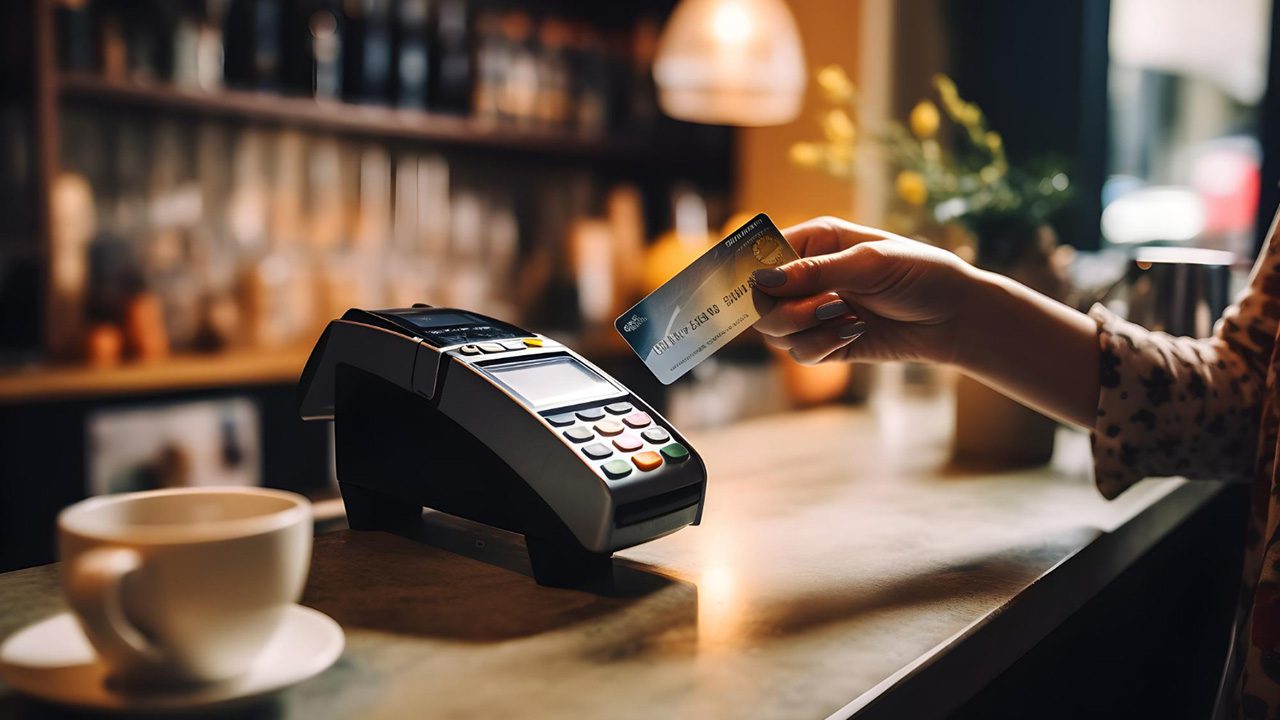
As we continue our exploration of the card’s evolution, we arrive at the present, which has been notably shaped by the COVID-19 pandemic. This crisis has expedited the transition from traditional contact payments, which involve inserting or swiping the card, to contactless transactions that require simply tapping the card on the terminal. It is estimated that by 2026, 81% of all cards worldwide will be equipped with contactless technology.
As we contemplate the future, it’s fascinating to see how payment cards have continually adapted, reinventing themselves over nearly a century to accommodate technological and societal advances, and how in doing so, they have given birth to some of today’s most iconic and prominent brands.


