

Chargeback fraud is defined as the process by which consumers fraudulently attempt to secure a refund using the chargeback process. Dave Wilkes, Founder and CEO of Chargeback, put it simply: “Chargeback fraud is essentially online shoplifting.”
First things first: what are chargebacks?
A chargeback is a credit or debit card charge that is disputed by the cardholder and consequently reversed and returned to the payment card. In essence, a chargeback is a type of refund for purchases made on credit or debit cards that results from a formal claim, as opposed to a straightforward return.
Chargebacks are distinct from voided charges, which are never fully authorized for settlement; a chargeback returns funds to the accountholder that were withdrawn in connection with an earlier purchase.
Why chargebacks occur
A chargeback occurs if the charge dispute is resolved in favor of the customer. There are many reasons why charges can be legitimately disputed:
- The cardholder wishes to return an item they purchased
- The cardholder never received the item for which they were charged
- The merchant accidentally duplicated or otherwise changed the charge
- The merchant charged a cardholder for a purchase they did not make
- The cardholder’s account information was compromised
Charge disputes most commonly occur as a result of cardholders requesting a refund for an item they purchased. If the merchant has a refund policy and the request is made within the acceptable terms and time limit of that policy, the merchant may voluntarily offer a refund in exchange for the return of the purchased item.
If a traditional refund is not permitted by the merchant, the cardholder may file a claim for a chargeback through the issuing bank (which may or may not be the same as the merchant acquiring bank). Card issuing banks are generally supportive of the chargeback resolution process.
It is worth noting that most chargebacks are legitimate, and result from merchants either failing to fulfill their obligation to the consumer, or to communicate contingencies in a timely fashion.
Chargeback fraud
Chargebacks are a prime target for fraud. Disputing a charge can be a lengthy process, and because the initial payment is made through a credit or debit card, the cardholder can attempt to resolve the charge dispute through the issuing bank instead of dealing with the merchant directly.
Unfortunately, both fraudsters and genuinely concerned cardholders may take this route, making it difficult to parse out sincere disputes from malicious ones.
“True fraud”
Chargeback fraud can encompass a variety of scenarios. One scenario is defined by the term “true fraud” which refers to a situation whereby the card or account information was stolen from the actual cardholder. The designation of “true” is a bit of a misnomer, as cardholders are perfectly capable of committing the same degree of fraud by lying about their intentions or the facts of the situation; the difference lies in the identity and intentions of the person disputing the charge (which, to a merchant or bank, may be a purely academic distinction – a loss is a loss).
Essentially, this kind of chargeback fraud falls under the umbrella of identity fraud.
True fraud may happen for several reasons:
- The cardholder’s physical credit or debit card was stolen.
- The cardholder’s card information was stolen.
- A fraudster created a “synthetic identity” using actual personally identifiable information (PII), such as social security numbers, first and last names, etc., and acquired a card in a real person’s name for purely fraudulent use.
“Friendly fraud”
“Friendly fraud” is a type of chargeback fraud that occurs when the initial purchase was made either by the cardholder themselves or by someone who the cardholder knows, such as a family member. A friendly fraud chargeback can be either intentional or unintentional. This type of fraud is also a misnomer, since “friendly” or not, the end result is still theft.
Below are two lists of friendly fraud examples, split into unintentional and intentional use cases, summarized from the Chargebacks911 web site:
Unintentional
- The cardholder did not understand the process.
- The cardholder experienced buyer’s remorse and tried to undo the purchase.
- A family member of the cardholder made the purchase without cardholder consent.
- The cardholder did not recognize the charge or forgot making the purchase.
- The cardholder did not qualify for a traditional refund.
Intentional
- The cardholder’s original intention was to get something for free.
- The cardholder did not return the item and chose to initiate the dispute anyway.
- The cardholder initiated a valid dispute but then decided to abuse the process.
- The cardholder did not like their purchase but had no other valid reason for a return.
- The cardholder ordered multiples of the same item with the intent to “warehouse” the stolen goods.
Recent trends in chargeback fraud
Fraud of all kinds is rising steeply, and chargeback fraud is no exception. Broadly, this increase is to be statistically expected, in part because of the rising volume of card-based or digital transactions: as card transactions go up, so do chargebacks, and therefore so do instances of chargeback fraud.

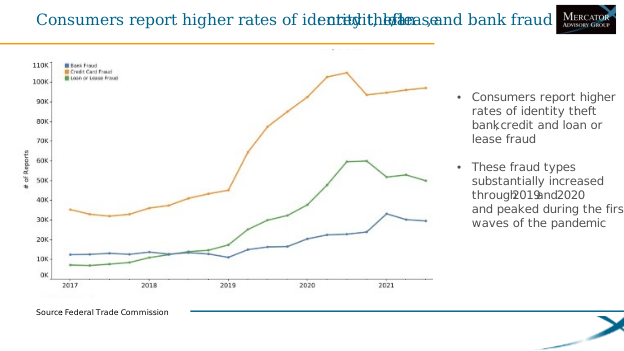
Important to note, from a 2018 Mercator report: “The card industry does not report dispute volumes, nor do regulators require the data. Using baseline data published in the New York Times, the working numbers… can be estimated to be 24.6 million suspect transactions, representing 4 basis points [0.04%] of Mastercard and Visa transaction volume.”
According to Chargebacks911, global losses due to e-commerce fraud grew 18% from 2020 to 2021. There are several specific reasons accounting for the rise in chargeback fraud:
- Increased popularity of online shopping – Advances in technology and the push online by the COVID-19 pandemic have boosted online shopping, where card-not-present (CNP) fraud is significantly easier to perpetrate than in-person fraud.
- Static regulations governing chargeback disputes – The payments industry is rapidly evolving, but the rules remain similar to their initial incarnations in the 1970s.
- Regulation E – Applies to debit cards, requires consumers to report fraud within 60 days of the charge appearing on a statement, and requires financial institutions (FIs) to provide a provisional credit after ten days of being asked to investigate
- Regulation Z – Applies to credit cards, requires consumers to report fraud within the same 60-day period, mandates card issuers stop charging interest on disputed charges, and protects consumers from merchants in the event of non-delivery of goods
- Customer preference for ease, convenience, and immediacy – Consumers may feel it is more efficient to file a chargeback than to deal with the merchant directly.
- Banks causing bottlenecks – If banks do not have a streamlined or automated system for handling chargebacks, cases do not receive due diligence.
- Complexity for merchant challenges – Merchants are “guilty until proven innocent,” can be hit with penalties for chargeback disputes, and must take time and energy to verify or challenge the disputes.
Chargeback Gurus offers the following statistics for chargeback distribution by type:
- True Fraud: 5-15% of overall disputes
- Friendly Fraud: 60-76% of overall disputes
- Merchant Error: 10-15% of overall disputes
Is chargeback fraud a crime?
The short answer is yes. It would seem self-evident that, as a variety of fraud, chargeback fraud is illegal. The long answer, however, is that although the chargeback process is legally mandated, the details are governed by card network policies and not the law. That is to say, determining whether a chargeback is fraudulent or not is neither an immediate nor cut-and-dry task.
Disputing a “friendly fraud” charge, for example, may prompt the issuing bank to offer validating the dispute in exchange for the cardholder pressing criminal charges on the bank’s behalf to recoup its losses from the fraudster. After all, if the cardholder earnestly believes their card was fraudulently used, why not pursue full remuneration? Well, if the “criminal” is the cardholder’s young child who made a foolish mistake on a computer, mobile device, or a video game, the illegality may be voluntarily waived, and the expense eaten by the cardholder rather than the bank or merchant.
Nevertheless, fraud of all kinds is punishable by law when confirmed, and can result in fines, loss of credit cards, and jail time. Matthew Thalken, Director of Client Operations and Card Services at Fiserv clarified: “Chargeback fraud can absolutely be treated as a crime depending on a number of circumstances including the value of losses, jurisdiction and prosecutorial discretion. However, most merchants will find that it is more practical to take an active role in the entire chargeback life cycle in order to reduce chargeback fraud, rather than to prosecute it as a crime.”
Can chargeback fraud be prevented?
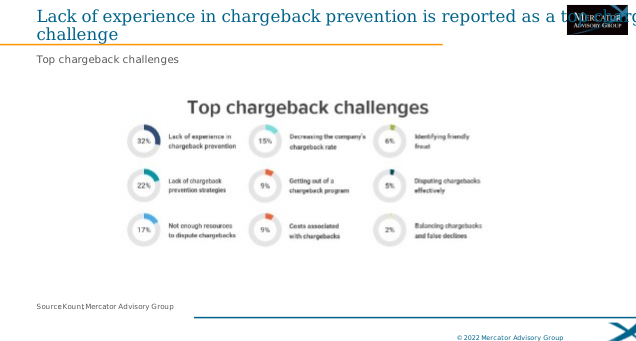
When all is said and done, chargeback fraud will never be entirely preventable. Like many kinds of fraud, the de facto initial impression is that the chargeback dispute is legitimate. The banks and card networks must investigate a claim before they can determine fraudulence, and until such a determination is reached, the fraud has successfully occurred. Some claims take months to resolve.
“[Merchants] need strong dispute intelligence to identify the root cause of disputes,” explained Suresh Dakshina, Co-Founder and President of Chargeback Gurus. “[They must also] implement strategies and change processes on how they tackle friendly fraud, true fraud, and merchant error to reduce the impact significantly.”

Chargebacks911 offers the following tips for chargeback fraud prevention:
- Using anti-fraud tools – CVV verification, address verification service (AVS), proxy piercing, geolocation, and 3-D Secure 2.0 help prevent fraud and lend confidence to honest buyers.
- Optimizing customer experience – Increasing customer service (delivery confirmation, customer notifications, open communication, etc.) and customer knowledge of merchant processes can help prevent the total number of chargebacks, making fraud easier to catch.
- Embracing secure technologies – Two-factor authentication and alternate payment methods, such as Apple Pay, can ensure more reliable card-not-present transactions.
- Employing blacklists and fraud scoring – Identifying bad actors and using fraud scoring can provide stronger and more accurate decision-making for merchants.
In summary, merchants should prevent chargebacks whenever possible and fight back against fraudulent chargebacks as a demonstrable deterrent. Dakshina elaborated: “Merchants have legal rights to fight a dispute if they think they have fulfilled their obligation and the dispute was filed wrong. You can also cancel chargebacks by calling the customer and requesting them to call their bank and withdraw the dispute.”
Chargeback Gurus offers the following data on chargeback prevention percentages through effective tools, strategies, and process implementation:
- Best Case: 40-50%
- Industry Average: 15-20%
- Worst Case: Less than 10%
How to fight chargeback fraud
Fighting chargeback fraud can take several forms. KYC (Know Your Customer) is one of the first steps merchants can take to push back against chargeback fraud. Creating an informative and fleshed-out profile for customers can help merchants identify early if customer behavior fits established patterns.
If a customer is known for honest and regular dealings with a specific merchant, a spate of high-value chargeback claims will raise red flags for potential fraud. Conversely, if an issuing bank is fielding excessive complaints from various customers about a specific merchant, then the problem may lie with merchant error instead.

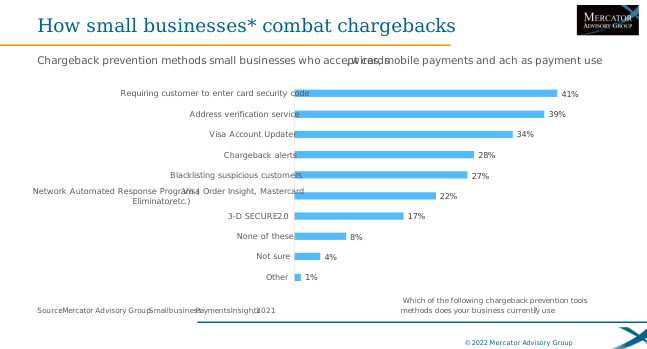
Note: The chart above only applies to e-commerce.
Mercator research adds: “Rapid reaction to disputed transactions provides a line of defense for credit card issuers. Fraudsters often test a credit card at an unattended payment acceptance device to ensure the card is still enabled. Once the compromised card proves to be active, the criminal has an opportunity to transact. For issuers, time is of the essence.”
Key players in the industry
Merchants can employ the expertise of key players in the industry to help allocate resources and develop strategies to reduce chargeback fraud risk:
Fintechs
- Chargeback Gurus – Utilizes their trademark Root-Cause Analyzer to assess 40+ data points, identify vulnerabilities, increase retention, and boost customer satisfaction
- Chargebacks911 – Boasts PCI Level 1 certification to deliver customized solutions that involve both prevention and representment, and which can reduce, recover, and repair any effects from chargebacks
- FIS – Offers in-store chargeback protection, chargeback dispute resolution, fast settlement time frames, and higher recovery rates for low-value transactions
- Fiserv – Recommends limiting returns of big-ticket items to shorter periods, proving delivery of an item through package photographs, and using a service provider capable of identifying patterns of fraudulent chargebacks
- Kount – Integrates dispute and chargeback management software with post-authorization tools from Verifi (A Visa Solution) and Ethoca, automatically responds to customer inquiries, sends timely alerts and notifications, and offers expert solutions that save money
Card Networks
- Mastercard – Focuses dispute resolution on reducing complexity, shortening processing timeframes, blocking invalid charges, eliminating chargeback cycles, implementing pre-chargeback rules, and decreasing cycle time by 25%
- Visa – Classifies claims resolution into four mutually exclusive and actionable groups for greater efficiency: fraud, authorization, processing errors, and consumer disputes
Intelligence Networks
- FICO® Falcon® – Uses transactional and non-monetary data to create machine learning predictive features aimed at differentiating non-fraud and fraud activity
The future of chargeback fraud management
Fraudsters play by different rules than banks, card networks, merchants, and law-abiding citizens of all kinds. For every new piece of technology or strategy that is introduced, criminals will locate a backdoor or new workaround. Data from the past several years strongly indicates that fraud is increasing steadily and is poised to continue growing, and chargeback fraud is unfortunately among the easiest kinds of fraud for lay people to attempt.
Moreover, the rules governing chargebacks have not been updated in decades and friendly fraud in particular will only get worse until the rules incorporate the realities of e-commerce and digital wallets and recognize that cardholders can be sufficiently validated by other means than the physical card.
The good news is that a litany of robust tools, keen strategies, and expert advisors exist to help merchants avoid high loss levels incurred via chargeback fraud. Through vigilance, knowledge, and determination, merchants must rise to meet the challenges of the modern marketplace.
Looking to dive deeper into chargebacks? Mercator Advisory Group has analyzed this topic extensively and we would encourage you to check out the following reports: