
When it comes to fighting fraud, especially in the payments world, businesses expect some collateral damage, i.e. good users being blocked in the attempt to keep out fraudsters. What happens, though, when too many legitimate customers get burned? Things like chargebacks and false positives create more friction, putting rifts between businesses and customers. The consequence? Brands are losing customers as they pick other companies to do business with in search of better experiences.
To cut through the fraud noise and further understand how businesses are — or aren’t — balancing fraud prevention and growth, Sift recently surveyed 500 fraud fighting professionals across North America, with responsibilities related to fraud, risk, mobile or e-commerce operations and strategies.
The report, titled Digital Trust & Safety: Aligning Security and Growth Strategies, looks at the latest fraud trends impacting payments and how criminals are becoming more sophisticated in their attacks across advancing technologies. Our findings show tension and mistrust on both sides of the fence as organizations struggle to break down the barriers between boosting revenues by meeting customer needs in personalized and innovative ways while protecting those same customers from fraud.
Friction is the enemy of growth… and trust
Our Digital Trust & Safety report discovered that while 77 percent of online businesses prioritize delivering frictionless experiences, 60 percent of those surveyed say fraud prevention blocks this goal. It also shows that for every revenue-generating call to action on a website or mobile app, there is a corresponding way for fraudsters to exploit that. For example, ‘Buy Now’ is an opportunity for payment fraud, ‘Log In’ is a chance for account takeover, and ‘Create Account’ is prime real estate for fake accounts.
The numbers prove it further: 64 percent of those surveyed say they continue to be plagued by payment fraud (aka credit card fraud); 63 percent battle fake accounts and 42 percent deal with account takeovers. A reason we see this happening is because current fraud fighting methods (i.e. rules-based systems) are failing to keep up with the technological advancements fraudsters are using in their attacks. It’s become a never-ending arms race that cuts into a brand’s good user base.
Rules-based systems are falling short
Traditionally, the mindset around managing risk has almost exclusively focused on loss prevention. The organizational structures, processes and tools that accompany legacy approaches to fighting fraud came from a singular goal: mitigating risk. While brands are focusing almost all of their energy on finding and stopping the one percent of bad users, they lose sight of the other 99 percent of legitimate users. What’s worse is that businesses are putting this 99 percent through the same accusatory flow in order to weed out the one percent of fraudsters. Very little emphasis, if at all, is placed on creating good experiences, increasing engagement or enabling revenue growth.
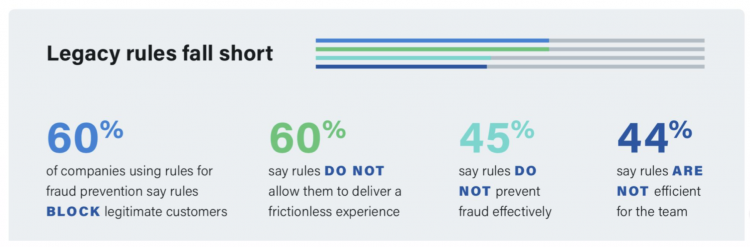
Businesses are starting to see just how much rules-based systems are falling behind:
Creating dynamic friction and preventing fraud with a Digital Trust & Safety strategy
The central challenge is finding a way to balance risk with growth, but companies are still investing in and applying similar methodologies as before, while expecting different results. To change this cycle, dynamic friction needs to happen, where maximum friction is applied on bad users and minimum friction on good users. One user journey for all doesn’t make sense, and never did, because each user will engage uniquely based on their goals and preferences. Companies need to tailor their user journeys based on the level of trust and fraud.
The current status quo isn’t working anymore and cannot stay the same. Fraud teams are asked to take on more than just chargeback rates and are now also responsible for user growth. Old tools don’t work anymore either — 44 percent of business say that rules are not efficient for their teams in fighting and staying ahead of fraud.
Building balance by strategically aligning risk and revenue decisions
Aligning risk and revenue decisions is the core of a Digital Trust & Safety strategy. It isn’t just about fraud prevention — the whole mindset about a business needs to change. It’s about gaining a broader perspective to see the whole customer journey rather than individual actions and looking at fraudsters’ overall behavior instead of singular attacks.
We’re evolving past legacy approaches to addressing risk and fighting fraud, and it’s about more than simply adding a new tool or procedural step. Trust and safety, especially in the digital realm, is about remodeling business strategies to effectively face challenges and wholly embrace opportunities. It requires a shift in philosophy, organizational structure and mindset.
A Digital Trust & Safety strategy helps balance growth with security, cross-functionally align the business, draw from the full customer journey and future-proof the team and technology stack. To harmonize growth and risk, a fundamental change is required in the mindset of a business, and in the mindset of entire industries, to fight and prevent fraud while also meeting consumers’ rising expectations for speed, convenience, and seamless experience across all channels.