PaymentsJournal
No Result
View All Result
SIGN UP
  • Commercial
  • Credit
  • Debit
  • Digital Assets & Crypto
  • Digital Banking
  • Emerging Payments
  • Fraud & Security
  • Merchant
  • Prepaid
PaymentsJournal
  • Commercial
  • Credit
  • Debit
  • Digital Assets & Crypto
  • Digital Banking
  • Emerging Payments
  • Fraud & Security
  • Merchant
  • Prepaid
No Result
View All Result
PaymentsJournal
No Result
View All Result

Economists Pin Blame for Rising Inequality on Automation

By Tim Sloane
January 11, 2022
in Analysts Coverage, Emerging Payments, Technology
0
0
SHARES
0
VIEWS
Share on FacebookShare on TwitterShare on LinkedIn
Economists Pin Blame for Rising Inequality on Automation

Economists Pin Blame for Rising Inequality on Automation

This New York Times article indicates several economists have discovered direct links between the deployment of automation and the rising income inequality. The economists identify what they term “so-so” automation as the most damaging. So-so automation is defined as automation that displaces workers with little or no productivity gain. It offers self-checkout kiosks as an example.

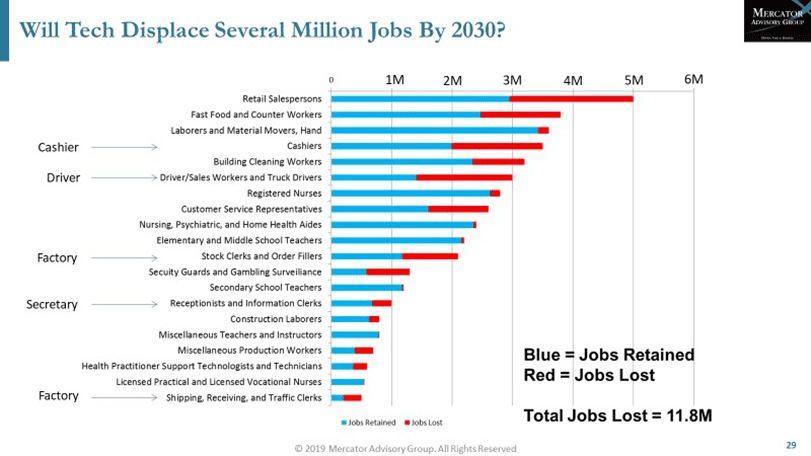
Interestingly, in 2019 Mercator delivered the following charts to several of our members. The first chart identifies our projections for the number of jobs most likely to be displaced by 2030 – and cashiers were close to the top of the list:
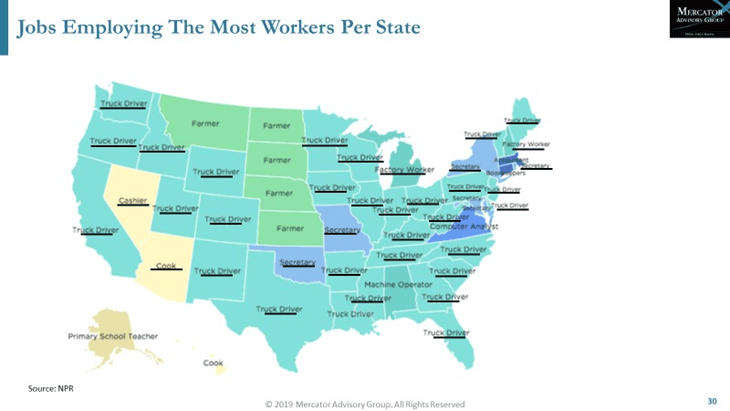
The second graphic matched several of the jobs identified as suffering losses to the states that have the greatest number of workers in those very same jobs:
High tech companies deploying AI have argued that AI will be used to augment existing workers, not displace them. But employees are not as reliable as a machine, so without some form of protection, those that can be displaced by automation likely will over time.  

“Mr. Acemoglu is no enemy of technology. Its innovations, he notes, are needed to address society’s biggest challenges, like climate change, and to deliver economic growth and rising living standards. His wife, Asuman Ozdaglar, is the head of the electrical engineering and computer science department at M.I.T.

But as Mr. Acemoglu dug deeply into economic and demographic data, the displacement effects of technology became increasingly apparent. “They were greater than I assumed,” he said. “It’s made me less optimistic about the future.”

Mr. Acemoglu’s estimate that half or more of the increasing gap in wages in recent decades stemmed from technology was published last year with his frequent collaborator, Pascual Restrepo, an economist at Boston University. The conclusion was based on an analysis of demographic and business data that details the declining share of economic output that goes to workers as wages and the increased spending on machinery and software.

Mr. Acemoglu and Mr. Restrepo have published papers on the impact of robots and the adoption of “so-so technologies,” as well as the recent analysis of technology and inequality.

So-so technologies replace workers but do not yield big gains in productivity. As examples, Mr. Acemoglu cites self-checkout kiosks in grocery stores and automated customer service over the phone.

Today, he sees too much investment in such so-so technologies, which helps explain the sluggish productivity growth in the economy. By contrast, truly significant technologies create new jobs elsewhere, lifting employment and wages.”

Overview by Tim Sloane, VP, Payments Innovation at Mercator Advisory Group

0
SHARES
0
VIEWS
Share on FacebookShare on TwitterShare on LinkedIn
Tags: AIArtificial IntelligenceAutomationEconomyTechnology

    Get the Latest News and Insights Delivered Daily

    Subscribe to the PaymentsJournal Newsletter for exclusive insight and data from Javelin Strategy & Research analysts and industry professionals.

    Must Reads

    physical digital debit

    Whether Physical or Digital, Debit Cards Are a Payments Mainstay

    June 5, 2026
    agentic commerce

    Separating Hype from Reality in Emerging Payment Trends

    June 4, 2026
    agentic commerce

    Searching for Trust in Agentic Commerce

    June 3, 2026
    stablecoin

    Stablecoin Success Will Depend on More Than Technology

    June 2, 2026
    A man standing outdoors uses a cryptocurrency trading app on his smartphone. This represents mobile finance, freedom, and real-time investing.

    How Gamification Helps Drive Engagement in Digital Banking

    June 1, 2026
    BIS Wants Central Banks to Move Faster with CBDC amid Looming Stablecoin Pressure

    The Next Phase for Prepaid Cards Could Be Stablecoins

    May 29, 2026
    Synthetic Identities

    A Victimless Crime: Why Synthetic Identities Demand Layered Verification

    May 28, 2026

    Stablecoins Are Turning the Remittance Business Model on Its Head

    May 27, 2026

    Linkedin-in X-twitter
    • Commercial
    • Credit
    • Debit
    • Digital Assets & Crypto
    • Digital Banking
    • Commercial
    • Credit
    • Debit
    • Digital Assets & Crypto
    • Digital Banking
    • Emerging Payments
    • Fraud & Security
    • Merchant
    • Prepaid
    • Emerging Payments
    • Fraud & Security
    • Merchant
    • Prepaid
    • About Us
    • Advertise With Us
    • Sign Up for Our Newsletter
    • About Us
    • Advertise With Us
    • Sign Up for Our Newsletter

    ©2026 PaymentsJournal.com |  Terms of Use | Privacy Policy

    • Commercial Payments
    • Credit
    • Debit
    • Digital Assets & Crypto
    • Emerging Payments
    • Fraud & Security
    • Merchant
    • Prepaid
    No Result
    View All Result