PaymentsJournal
No Result
View All Result
SIGN UP
  • Commercial
  • Credit
  • Debit
  • Digital Assets & Crypto
  • Digital Banking
  • Emerging Payments
  • Fraud & Security
  • Merchant
  • Prepaid
PaymentsJournal
  • Commercial
  • Credit
  • Debit
  • Digital Assets & Crypto
  • Digital Banking
  • Emerging Payments
  • Fraud & Security
  • Merchant
  • Prepaid
No Result
View All Result
PaymentsJournal
No Result
View All Result

Interconnected Defi Increases Attack Vectors: $600 Million in Crypto Stolen From Poly Network

By Tim Sloane
August 12, 2021
in Analysts Coverage, Blockchain, Cryptocurrency, Digital Assets & Crypto, Fraud & Security, Fraud Risk and Analytics
0
0
SHARES
0
VIEWS
Share on LinkedIn
Interconnected Defi Increases Attack Vectors: $600 Million in Crypto Stolen From Poly Network

Interconnected Defi Increases Attack Vectors: $600 Million in Crypto Stolen From Poly Network

Criminals hacked their way into the Poly Network that enables users to swap tokens across multiple blockchains. Once into the Poly Network, the hacker used a vulnerability in smart contracts to steal from multiple blockchains stealing more than $600 million in various cryptocurrencies. 

The reaction from the crypto community was swift and so far it appears the hackers have returned $258 million of the ill-gotten gains:

“In making its announcement, Poly Network tweeted: “We call on miners of affected blockchain and crypto exchanges to blacklist tokens coming from the [aforementioned] addresses.” The platform also wrote: “We will take legal actions and we urge the hackers to return the assets.”

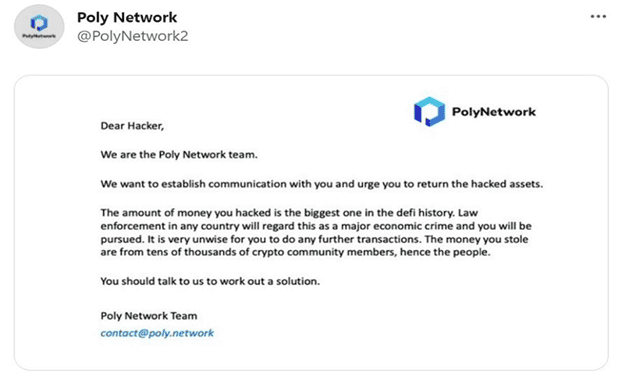
In a follow-up post Tuesday addressed to the hacker, Poly Network wrote: “We urge you to return the hacked assets. The amount of money you hacked is the biggest one in the defi history.”

It continued: “Law enforcement in any country will regard this as a major economic crime and you will be pursued.”
Update

As of Wednesday, the Poly Network hacker had reportedly returned $258 million of the stolen funds, according to London-based blockchain analysis firm Elliptic.

Earlier Wednesday, Poly Network initially confirmed that the hacker had returned at least $4.8 million of the stolen assets.

The hacker’s return of funds “demonstrates that even if you can steal cryptoassets, laundering them and cashing out is extremely difficult, due to the transparency of the blockchain and the use of analytics,” says Tom Robinson, co-founder and chief scientist at Elliptic. “In this case, the hacker concluded that the safest option was just to return the stolen assets.”

According to the blockchain firm, the hacker has also posted a Q&A in an ethereum message, calling the Poly Network “a decent system” and “one of the most challenging attacks.” The hacker claims to have used a temporary and “untraceable” email and IP address.

A Poly Network spokesperson tells ISMG that “the hacker exploited a vulnerability, which is the _executeCrossChainTx function between contract calls. Therefore, the attacker uses this function to pass in carefully constructed data to modify the keeper of the EthCrossChainData contract.

“It is not the case that this event occurred due to the leakage of the keeper’s private key,” the spokesperson adds.”

Overview by Tim Sloane, VP, Payments Innovation at Mercator Advisory Group

0
SHARES
0
VIEWS
Share on LinkedIn
Tags: BlockchaincryptoCryptocurrencyCybercrimeDeFiFraudHackers

    Get the Latest News and Insights Delivered Daily

    Subscribe to the PaymentsJournal Newsletter for exclusive insight and data from Javelin Strategy & Research analysts and industry professionals.

    Must Reads

    identity theft protection services

    The Missing Piece in Banks’ Identity Protection Strategy

    July 24, 2026
    African cross-border payments

    Africa’s Payment Problem Isn’t What You Think It Is

    July 23, 2026
    remittance platform

    The Case for Not Building Your Own Remittance Stack

    July 22, 2026
    instant payments fraud, business payments

    When Faster Isn’t Better: The New Rules of Business Payments

    July 21, 2026
    Gen Z banking

    For Gen Z, Banking Loyalty Begins with Payments

    July 20, 2026
    syria visa mastercard

    Visa’s Stablecoin Platform Marks the Next Phase of Digital Payments

    July 17, 2026
    cross-border payments

    Beyond Pix: The Cross-Border Layer Latin America Is Building Next

    July 16, 2026
    digital euro

    Can the Digital Euro Be the Difference Maker the EU Needs?

    July 15, 2026

    Linkedin-in X-twitter
    • Commercial
    • Credit
    • Debit
    • Digital Assets & Crypto
    • Digital Banking
    • Commercial
    • Credit
    • Debit
    • Digital Assets & Crypto
    • Digital Banking
    • Emerging Payments
    • Fraud & Security
    • Merchant
    • Prepaid
    • Emerging Payments
    • Fraud & Security
    • Merchant
    • Prepaid
    • About Us
    • Advertise With Us
    • Sign Up for Our Newsletter
    • About Us
    • Advertise With Us
    • Sign Up for Our Newsletter

    ©2026 PaymentsJournal.com |  Terms of Use | Privacy Policy

    • Commercial Payments
    • Credit
    • Debit
    • Digital Assets & Crypto
    • Emerging Payments
    • Fraud & Security
    • Merchant
    • Prepaid
    No Result
    View All Result