Recently, I wrote a data-driven piece revealing which countries are home to the most expensive report misconduct. Several of the results were extremely interesting, but the most fascinating piece of data was redacted because it needed to be looked into more thoroughly.
That data point was this: only 1% of expense report items flagged for review by leading automated expense report audits AI software, AppZen in China are ultimately rejected by the client company.
This 1% figure sits at the very bottom of the international list; no other country is even close. For example, Japan, only a few hundred nautical miles away across the East China Sea, ranks in the bottom half of flagged expense dollars rejected, with a much more robust 18%. Here’s the data from the last blog post, but with China put back in.
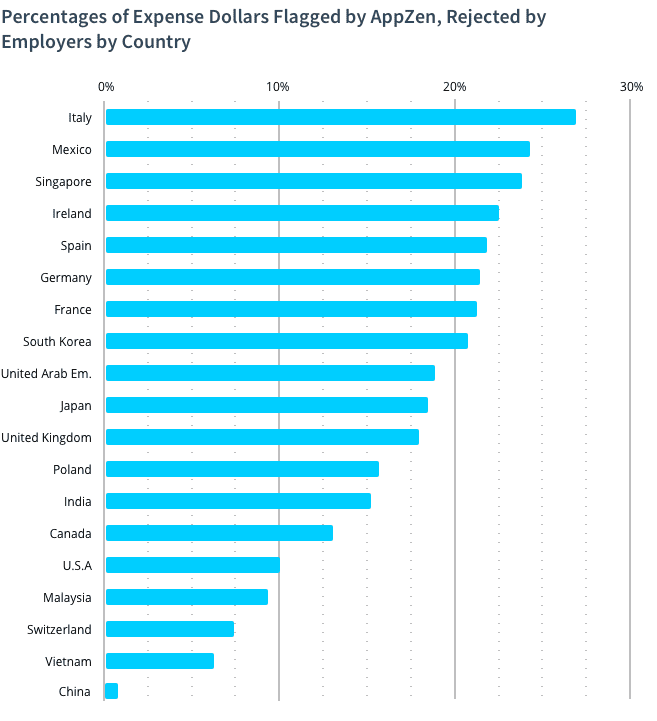
So what are the explanations for this oddly-low Chinese rejection rate? The answers are somewhat dubious and connect to transfers of wealth.
Like most nations, China has its unique accounting complexities and one example is the country’s Fapiao system, in which receipts and invoices are actual official tax documents printed on the spot. The goal of Fapiao was to create a transparent system spitting out real-time tax documents at points of purchase across the country, but that hasn’t stopped enterprising folks from coming up with schemes to take advantage of it.
For example, imagine taking 40 expo guests to dinner after a conference. In America, the hosting employee would simply receive a receipt for the pricey dinner which he would then expense for reimbursement upon returning from the trip. The company submits that receipt as part of its tax return at the end of the year.
Now let’s say some out-of-policy behaviour takes place at this dinner; maybe the host employee decided to order several $200 bottles of wine, easily exceeding the $50 bottle company policy limit. AppZen would catch the out-of-policy misconduct on the expense report in this example.
But in China, Fapiao are actual tax documents and business-related expenses are sometimes used to offset revenue, which allow companies to bring down their corporate income tax. Accordingly, managers subtly encourage their staff to collect Fapiao, and turn the other cheek instead of scrutinizing the documents.
In other words, Chinese corporations can lower their tax bills by indirectly transferring a fraction of those funds to employees via liberal unwritten expense report oversight thereby making them happier, at the expense of The Party’s tax revenue.
The less cynical explanation picks up the same thread of employee satisfaction without looping in Fapiao: the Chinese are, in general terms, lax in their enforcement around expenses; they turn a blind eye to most expense ambiguity to help incrementally raise employee take-home pay. In other words just as Silicon Valley companies are happy to supply their employees with millions of dollars in free meals and snacks at the office to supplement incomes, many Chinese companies are similarly, indirectly liberal outside the office, around expenses.
Either way, the title of this article is somewhat misleading. The Chinese have an average number of expense items flagged for potential conduct by AppZen relative to other countries. The difference is that Chinese companies are choosing to reject these flagged expenses at an unusually-low rate of 1%. The reasons for this are Fapiao loopholes and cultural norms around allowing employees liberties with their work expenses.
Josh Anish is Senior Directing of Marketing at AppZen,the world’s leading solution for automated expense report audits that leverages artificial intelligence to audit 100% of expense reports, invoices and contacts in seconds.