


Fees are an essential part of the payments industry. In order to exchange money between different networks or people, a fee is typically required to facilitate the transaction. This makes understanding fees important to any company in the payments industry. However, payment-related fees can be strikingly complex.
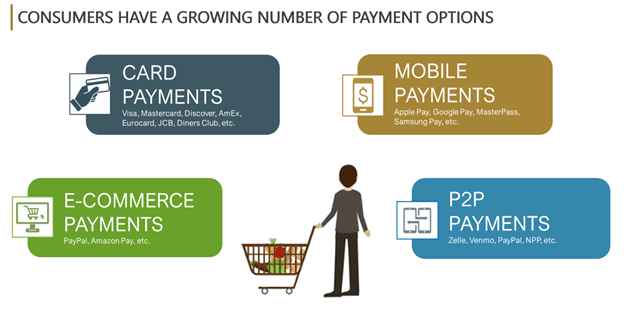
A large part of this complexity comes from the fact consumers can choose from a variety of payment types. These include card payments, mobile payments, P2P transactions, and e-commerce payments. Since there are numerous companies offering each of these payment types, competition can be fierce.
Further complicating the landscape is that all of these transaction types involve a growing number of participants. For example, a typical card transaction involves the consumer, merchant, payment gateway, merchant acquirer, payment network, and issuing bank. Each participant will either be an originator or a recipient of fees – some participants might even be originators as well as recipients of fees depending on contractual relationships.
A brief look at different fees
Since all participants involved in the entering, routing, authorizing, and settling of payment transactions either pay fees or receive fees, there are many different types of fees.
Although there are some variations, the following are the general types of fees that occur during the payments cycle:
- Interchange Fees: Interchange fees are paid by the payment service provider (PSP) to an issuing bank or the issuing bank processor through a payment network. The fee rates are set by the payment card networks and depend on a variety of variables, including the transaction amount, payment card type, and acceptance method, among other factors.
- Assessment Fees: This type of fee is paid by either the PSP or the merchant to the payment card network handling the purchase.
- Payment Gateway Fees: Merchants connected to a PSP via a payment gateway provided by a third party are subject to a separate set of fees charged by that payment gateway provider.
- Issuing Bank Processor Fees: When outsourcing processing entirely, the issuing bank will pay its processor an operations fee, which can vary depending on the fee structure.
- Payment Service Provider Fees: PSPs also include a variety of fees to cover their cost of doing business, consisting of flat fees on a per-transaction basis, a percentage of the total transaction amount, or a combination of both.
BHMI is helping companies understand fees
It is important that companies involved in payments understand what types of fees are out there and how fees can be utilized to increase revenue. To that end, BHMI—an industry leading company that has created primary business applications since 1986—is hosting a webinar from 11:00 AM to 12:00 PM (EDT) on July 16, 2020.
The webinar will feature Casey Scheer, Director of Marking at BHMI, and Cheryl Fitzgarrald, Senior Project Manager at BHMI. During the hour-long discussion, Scheer and Fitzgarrald will describe the different fees and commissions in the payments industry, and then offer some best practices for developing solid, effective fee structures.
The webinar will also outline how BHMI’s Concourse — Fees & Commissions™ solution allows for the creation of an almost unlimited range of fee configurations through its real-time, rules-based software. By simplifying the task of creating and managing complex feeing configurations, BHMI empowers processors to increase revenue and stay competitive.
Those interested in BHMI’s “Maximizing Pricing & Fee Structures” webinar can register here.


