

Small-business owners want to focus on serving their customers and growing their business, not deal with time-consuming manual processes that come with managing payments and invoices. And they’re not getting the help they need. A recent survey showed that 64% of small businesses were unsatisfied with their current payment offerings, and nearly 20% said they will leave or consider leaving their current financial institution.
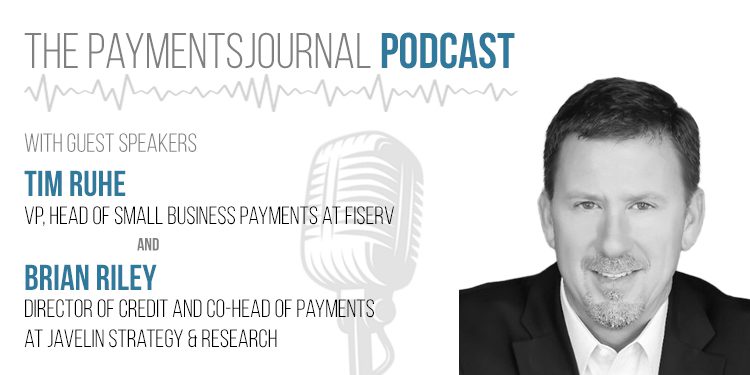
What are these businesses looking for in a financial institution, and what is being done to meet those needs? In a recent PaymentsJournal podcast, we asked Tim Ruhe, VP, Head of Small Business Payments at Fiserv, and Brian Riley, Director of Credit and Co-Head of Payments at Javelin Strategy & Research, about the pain points that small businesses experience and what FIs can do to serve them better.
Looking for Simpler Solutions
Small-business owners want to focus first and foremost on the business itself, not on collecting and processing payments. “They don’t have a lot of time for managing all the payment inflows and outflows there,” Ruhe said. “But instead, they typically end up using two to four tools to manage how they pay suppliers, how they collect invoices, how they collect payments from their customers, and how they send invoices. What they want is a single place to manage all that—and they don’t really have good answers for that today.”
Ruhe has seen many business owners with invoices stacking up—on paper and in emails—alongside accounting software that they’re trying to integrate into the business. Many operations remain under-digitized as business owners try to deal with sending out bills and getting paid. “We’ve found that 56% of small-business owners consider cash flow and invoice payment management an ongoing pain point,” Ruhe said. “And 81% of small businesses expect to create payment flows that align with their businesses, and they don’t believe financial institutions are delivering on that yet.”
According to Riley, sometimes it’s easier for small businesses to log all of their transactions in their personal account, but that’s not a good business procedure. “It leaves you exposed to tax problems, leaves you exposed to opportunities, and it doesn’t set the stage for growing the business,” he said. “That’s something we should address with more integration and capabilities.”
Fit for Purpose
What these business owners seek is a well-engineered process that takes them all the way through from delivering an invoice to receiving payments. With a wider variety of payment methods available than ever before, that can be harder than it looks. “There’s a bit of a rallying cry that we’re hearing from small businesses that says give us a fit for purpose,” Ruhe said.
Fiserv sees its mission as helping those small businesses grow by taking the complexity of managing payments and invoices off the table and simplifying their owners’ lives. Fiserv knows these business owners want a single financial institution to turn to for such solutions.
“We’re hearing from almost every FI that improving their small-business capabilities—and specifically their small-business payment capabilities—is a top priority in the next year or two,” Ruhe said. “If you’re hitting a low point in your cash flow and need to pay with credit cards, those are tools and capabilities that many small businesses don’t have access to.”
A new study from Intuit shows that a significant number of small businesses have had to rely on credit cards as a source of capital over the past 12 months. In the United States, 30% of small businesses have used credit cards as a primary or secondary source of funding, while only 22% relied on a loan or a line of credit.
These businesses don’t want to go one place for credit cards and another for loans. They want an easily accessible, comprehensive view of their cash flow that helps them decide when they need a line of credit or to use a credit card.
Conclusion
Integrating all these cash flow needs has been a priority for Fiserv. “What we’ve been hearing is, ‘I need digital solutions that map to the work that has to be done, I need the jobs to be done right, and I need to bring all my invoices into one place so I can see everything that has to be paid,’” Ruhe said. “That’s what inspired us to launch CashFlow Central, which we (recently) announced as a powerful, simple, integrated, easy-to-use tool set for small businesses to pay and get paid through their financial institution.”
CashFlow Central combines easy-to-use accounts payable and receivable workflows with Fiserv’s large biller and merchant network and high scale payment processing capabilities. “With CashFlow Central, we help the small-business owner get fully automated so they can spend more time on growing their business,” Ruhe said.
That kind of holistic approach empowers the FIs and the small businesses. “While financial institutions are building deposits and portfolio loans, it also helps the small business automate their tasks,” Ruhe said. “They can speed up their payments and get paid reliably and electronically. And that frees the small business to focus on what is most important: managing and growing their business.”


