Buy Now, Pay Later is making headlines as a great option for consumers looking to make purchases without breaking the bank. For financial institutions and others in the payments industry, not entering the competitive BNPL space is no longer an option.
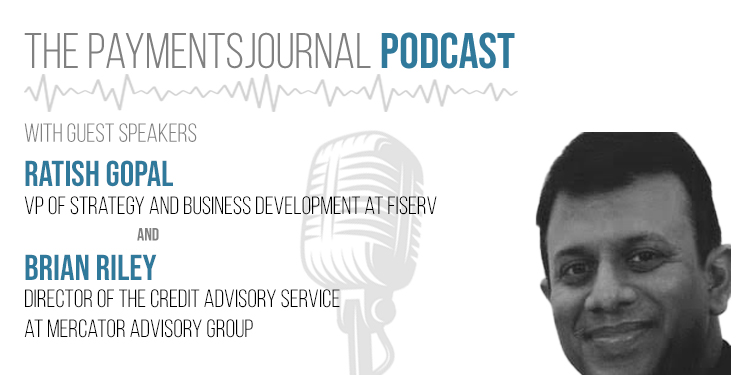
To learn more about how financial services organizations can become more involved in Buy Now, Pay Later lending, PaymentsJournal sat down with Ratish Gopal, VP of Strategy and Business Development at Fiserv, and Brian Riley, Director of Credit Advisory Service at Mercator Advisory Group.
Now trending: Buy Now, Pay Later
Buy Now, Pay Later (BNPL) is a short-term installment lending option that allows customers to buy items at retailers without paying the entire amount up front. Instead, they pay it off in a set number of installment payments over time. Retail installment lending is not a new concept. In fact, installment lending was pioneered by companies in the 1970s and 1980s. However, it is now experiencing a resurgence in the form of Buy Now, Pay Later.
“Instead of empowering a customer with a credit card, we are empowering merchants with the ability to do financing at the point of sale. Now, we expect rapid growth in the United States as this starts to form and mature,” said Riley. While fintech startups once dominated BNPL, that is no longer the case. There are many players today, such as banks and card issuers, that offer options appealing to merchants and consumers alike.
According to Gopal, the trend toward BNPL “reflects the fundamental way consumers view things and their willingness to pay at a transactional level.” He used the example of cable television to underscore his point. “Once upon a time, consumers paid $200 per month for cable TV to have access to as many channels as they want. But with the advent of streamers, consumers became accustomed to only paying for what they watch,” he said.
Consumers are experiencing a similar natural shift to BNPL because, like cable television, it is at the case-by-case, transactional level. Instead of being able to make as many transactions as possible within a set credit limit, consumers can pick and choose which transactions they want to obtain financing for.
It is not only the consumers who are benefiting. BNPL also allows merchants to offer a lending product without relying on bank-grade lending where banks have strict regulatory requirements. “One of the reasons merchants have really loved Buy Now, Pay Later lending is that it’s pretty easy to get your customer through the authorization process and get them approved for a loan,” added Riley.
Tech-savvy partners help banks optimize BNPL
Although fintechs blazed the path to BNPL, financial institutions and their card issuers and enablers have shown that banking technology can quickly get them up to speed. “For example, Fiserv, one of the largest fintech players, offers issuers a product in the BNPL space called ILLOC–installment loan on credit,” said Gopal. “From a feature perspective, they are getting that same transactional-level paying installment feature with all the heavy lifting done by someone like Fiserv.”
Financial organizations offering BNPL can work with their processing partners to optimize their offerings. This makes it possible for consumers to utilize the BNPL option offered by their existing FI instead of having to build a new relationship with another provider.
“What makes this product even more compelling to the issuers is that this BNPL product from Fiserv comes fully packaged with the Fiserv digital product called CardHub. So your user interface, user experience, and [all] of those good aspects are fully taken care of. If you’re an issuer, you know you need to be in this space. You [can] leverage your partners and someone like Fiserv is ready to serve you as we speak,” Gopal added.
What could slow down this juggernaut?
With rapid expansion since 2019, BNPL is without a doubt a lending juggernaut. However, there are factors that could impede or slow down some of its growth. “There are some external factors to consider. Specifically, you have the consumer confidence, inflation, unemployment, and, of course, the big one: regulation,” noted Gopal.
While BNPL has gone largely unregulated in the United States, regulators have begun to take notice of the area. Most recently, the Consumer Financial Protection Bureau (CFPB) issued a series of orders to five BNPL providers: Affirm, Afterpay, Klarna, PayPal, and Zip. It intends to collect information on the risks and benefits of this fast-growing financing option. In November 2021, The Federal Reserve bank of Kansas City published an article covering how regulations are creeping into BNPL. And in early 2020, the California Department of Financial Protection settled lawsuits with traditional BNPL players that resulted in $2 million in fee refunds to California consumers.
“The fact remains that as the industry increases by leaps and bounds, the regulators are going to start taking notice. And from an issuer perspective or from a traditional financial institution perspective, the way I would look at this is regulations [are] something that these financial institutions play with on a daily basis,” said Gopal.
Of course, banking is already an incredibly regulated space. As a result, banks and financial institutions are very accustomed to regulatory scrutiny and compliance requirements. If BNPL becomes more regulated, it will become a matter of pivoting to meet those new requirements.
Additionally, the demand for BNPL still presents a great opportunity for banks. “There is a lot to consider as the economy starts to shift, so there could be a softening in that,” warned Riley. “But one thing we have seen is that there is a preference for consumer loans, and that opens up a wide range of opportunities for lenders to get into. And maybe they haven’t focused on that, but integrating [BNPL] directly into their card platform creates a long-term opportunity.”
The takeaway
Buy Now, Pay Later has seen tremendous growth in recent years. While it was once dominated by fintech players, banks and other traditional financial services organizations now have the opportunity to get involved in the space–and it is an opportunity they cannot ignore.
But that does not mean they have to create their own in-house BNPL lending product. Rather, they can collaborate with an experienced partner that already has the tools needed to thrive in an increasingly competitive space. “Partner now with your processor or issuer partner, like Fiserv, and start using some of their products,” Gopal advised.