There is a common misconception that business credit cards are only for midsize to large businesses, as small business owners commonly use personal credit cards for their businesses. Furthermore, marketing for business cards has not traditionally been targeted at small business owners.
However, banks are starting to rethink that strategy. They see small businesses as essential for business card portfolio growth and are using innovative expense management tools to help attract small business customers.
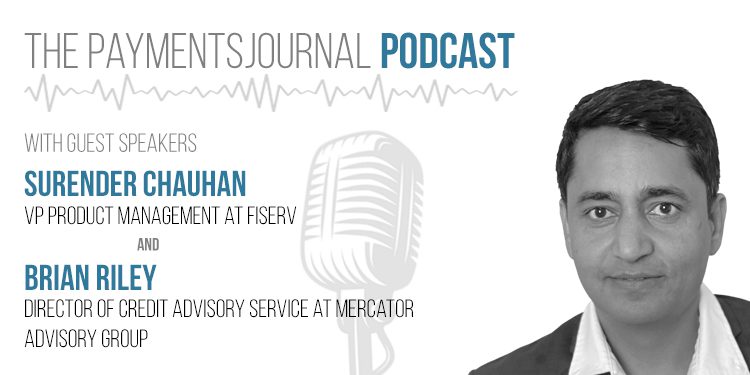
To find out more about how business credit card management plays a role in driving business card portfolio growth, PaymentsJournal sat down with Surender Chuahan, VP Product Management at Fiserv and Brian Riley, Director of Credit Advisory Service at Mercator Advisory Group.
Businesses’ Credit Cards as a Revenue Driver
Offering business credit cards represents an attractive revenue opportunity for financial institutions. The average ticket size of a business transaction is 2.4 times that of a consumer ticket.
Historically, financial institutions have focused on midsize to large businesses. Recently, the landscape has changed a lot with the gig economy in the picture, and we are seeing a huge growth of small businesses. As Chuahan noted, “there are 32.5 million small businesses in the US alone.”
Most of these small businesses need cash, liquidity, and lending. Arguably, the credit card is the best way to do that. Among other benefits, credit cards provide a grace period to make payments.
Research shows that many small business owners just use a personal Visa or Mastercard. This practice is convenient, but it also has drawbacks.
If you go through an IRS audit, you’re going to have to reveal all your [personal] purchasing habits to the IRS if they’re on your card. Having a separate business credit card for expenses keeps personal and business activities separate.
There are other drawbacks to using a personal credit card for business purposes. Chuahan described how it can be frustrating for employees who use their own credit cards for company purchases and then have to file for reimbursement through a cumbersome process.
“You don’t want to get stuck because there is somebody who’s waiting to get some approval because they have to, they need to go and get reimbursed back,” Chuahan said.
Business Challenges Around Credit Card Use and Expense Management
Small businesses face many challenges today when it comes to credit card use and expense management. These challenges include proper expense tracking, controlling those cards for employees, and risks with file sharing.
Chuahan outlined the tools needed for a business credit card to work well for a small business. Small businesses need clear visibility of how much they have spent so far, and how much credit and cash is available. Also, the management system must be mobile.
An ideal business credit card system would provide flexibility around payments and transparency of what has already been purchased, but it might also allow the bank to give small business customers different options for different products.
Chuahan said, “If my bank knows how much I spend [and] where I spend, the bank might be able to leverage this information to provide competitive offers to customers.”
For example, say that a bank sees that a small business customer buys supplies from XYZ company at a particular price. The bank may have many other businesses that buy similar kinds of stuff elsewhere at a lower price. The bank could then provide this information to this small business, which could then adjust its buying patterns.
AI’s Effect on Small Businesses With Expense Management and Small Business Cards
Artificial intelligence (AI) is revolutionizing many different sectors of the economy, enabling the optimization and automation of various types of systems. Expense management will be no different. AI will help small businesses with business credit cards spend less time on expense management, freeing up time for other tasks.
In the case of business credit cards, AI will most likely be applied to expense management. An AI tool could be programmed to learn about a business owner’s spending habits and use this information to create a categorization system that will help with accounting later on. Chuahan explained, “The tool can automatically put different expenses into the right tax category so that at the end of the year, when you’re filing your expenses, you’re just clicking a button and sending the data to your accounting system.”
Fiserv has built a tool that can help small businesses manage all their expenses automatically. The tool learns the pattern of what small businesses are doing, eventually do it for them, and let small business owners focus on other tasks.
The future is bright for business credit cards. New features will make it easier to run a business, and the benefits will make those cards a no-brainer for small business owners. For more information on all of these topics, listen to the podcast in which Chuahan talks about these issues in more detail.