

Although the business payments environment has seen progress with digital tools in recent years, accounts receivable and accounts payable functions of small, medium, and large companies still predominantly rely on the use of inefficient paper and manual processes. Now, the unprecedented COVID-19 pandemic has increased the urgency for corporates, billers, and financial institutions to replace the paper processes that still exist in business payments.
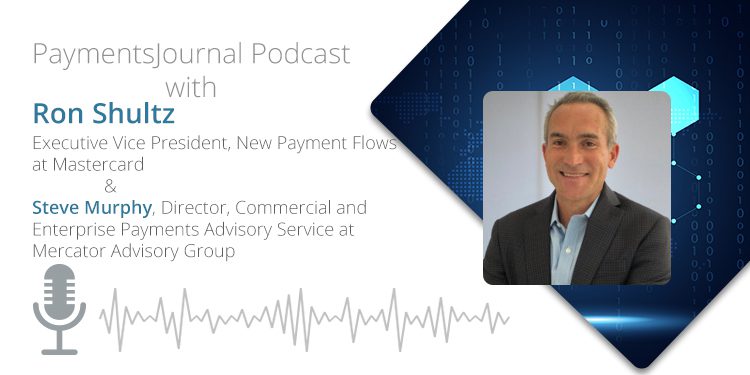
To talk about why COVID-19 should serve as a catalyst for great advancements in digital tools, PaymentsJournal sat down with Ronald Shultz, Executive Vice President, New Payment Flows at Mastercard and Steve Murphy, Director of Commercial and Enterprise Payments Advisory Service at Mercator Advisory Group.
Digital Tools Benefit Businesses and Consumers Alike
Despite progress, the business payments environment has not come close to the rapid adoption of digital tools by consumers; research has shown that 79% of consumers worldwide are now using contactless payments. Between February and March 2020 alone, contactless payments doubled, while paper checks declined by 4%.
The use of digital payment tools results in greater efficiencies in accounts payable and accounts receivable processes, improves cash flow management, and can provide consumers and businesses with payment optionality during and after the pandemic. There will also be lingering health and safety concerns around manually processing paper and needing to be in-office to receive and sign paper invoices and checks. Further, in the post-pandemic world, cost management will be top of mind for organizations looking to keep operating expenses down.
For these reasons, it’s time for organizations to aggressively attack and replace the inefficient and costly paper processes that still exist within business payments. In other words, said Shultz, “COVID-19 should be a catalyst for great advancements in electronic payments.”
Updating Business Payment Processes
It’s more important now than ever before to offer electronic payment choices, which means businesses still reliant on paper need to turn the page and update their processes. A good way to start is to identify all the paper products, whether it be invoices, incoming, or outgoing payments, and match digital solutions to them.
Virtual cards are one great option available to help businesses digitize payments. They were introduced as a way to enable buyers to use a card with the confidence that it is a one-time use product for a specific purchase. While convenient for buyers, however, suppliers on the receiving end still needed to manually process the transaction, and then reconcile it at a later date by matching payments to invoices.
“On both the payables and receivables side, that’s something that really has caused inefficiency in the back office. That’s what’s happening with dozens and dozens of receivables clerks, matching payments with invoices,” explained Shultz.
Straight Through Processing
In response to that challenge, Mastercard developed Straight Through Processing (STP), an automated payments tool that takes the burden away from suppliers having to receive a card number, send it to an acquirer, process the transaction, and manage the reconciliation. With STP, Mastercard assumes the burden by automating the reconciliation process, taking that safe virtual card number, processing the transaction, and sending the reconciliation information to the supplier in the form that it needs.
“As invoices are automated and digitized, it gives organizations an entry point into a digitized cash cycle, meaning that procurement, payables, receivables, and reconciliation can all be tied together,” added Murphy. “They can also develop opportunities for supply chain finance along the way; all of this convergence is facilitated by the ability to bring these products together.”
Improving Cash Flow for Businesses
While access to cash flow and faster payments may not be as significant to large, well-funded corporate organizations, it is very meaningful to small and medium-sized businesses. Small business owners pay higher interest rates because of their heightened risk portfolio, making cash flow a priority at all times.
By looking to card programs, electronic bill pay systems, supply chain financing, and other programs, these businesses can benefit by taking advantage of differences in costs among transaction players.
Bill Pay Exchange
Fortunately for small and mid-sized businesses, there are ample digital payment tools available, many of which are fueled by Mastercard capabilities in corporate cards, automated payables, bill pay, and supply chain finance.
One such tool, the Mastercard Bill Pay Exchange, enhances online bank bill pay and offers a simple and convenient bill pay experience for consumers. Consumers can go to the place they trust most–their bank–to easily set up billers, receive a bill, see bill details, and manage multiple bills in one place, including specifying when and how much to pay.. That same digital site can contain budgeting tools, which are particularly useful at a time when consumers and small business owners are struggling financially and putting some extra focus on budgeting and cash flow.
Accelerating Digitization with Fintech Relationships
By partnering with fintechs to leverage technology, banks will have the capabilities needed to better serve their customers. Fintechs often offer unique digital solutions that give consumers and businesses choices of where, when, and how they want to pay.
Shultz offered two examples of how Mastercard has worked with fintechs to accelerate the race to digitize and better serve its customers:
- AvidXchange: Mastercard partnered with AvidXchange, a leading fintech in the accounts payable automation space, in 2017 to give businesses the ability to automate the payables process, and capture data to streamline reconciliation.
- Transactis: Mastercard acquired Transactis, which builds and hosts bill payments sites for small and mid-sized B2B and B2C companies, in 2019 to give consumers an easy online space to view and pay bills.
The Takeaway
There is no better time than now for businesses to focus on the digital payment tools available to them. The New Payment Flows team at Mastercard has a suite of B2B technology solutions that help corporates, financial institutions and billers digitize payments, maintain cash flow and create efficiencies in account receivable, account payable and billing processes during and after COVID-19.
For more information, please reach out to your Mastercard representative, or send an email to [email protected]


