The economics of the credit card business have always depended on balancing transaction volume with lending income. While interchange revenue and rewards drive consumer engagement, issuers generate the majority of their profits from customers who carry balances from month to month. As economic uncertainty grows, that balance becomes increasingly important, especially as rising delinquencies, regulatory pressure, and changing consumer spending patterns reshape issuer profitability.
Recent research from McKinsey highlights just how dependent the industry remains on revolving balances. Although consumers who pay their balances in full each month account for a significant share of card usage, the bulk of issuer revenue continues to come from interest income generated by revolvers. That concentration creates both opportunity and risk as the credit cycle evolves.
In a recently published McKinsey report, the firm discusses BNPL lending options, but they include some interesting tidbits about credit card account-level revenue derived from sampling and their Global Payments model.
The model looks at revenue by consumer credit cards in two components, those customers that transact with their accounts and settle balances each month and those that revolve, by carrying over their transactions.
Transactors do not pay interest because they bring their balances to zero each billing cycle, and revolvers tend to transact less because they exhaust much of their available credit. According to the recently published report,
However, today’s issuers face circumstances that make profitable growth harder to sustain.
Their profits rely mainly on revolvers or customers who carry a balance on their credit-card account from month to month.
Revolvers make up around 60 percent of credit-card accounts, but they generate 85 to 90 percent of issuers’ revenues, net of rewards.
Profit per account stands at around $240 for revolvers but at just $25 for transactors, or customers who pay off their balance every month.
Building a business on revolvers rather than transactors can be a risky situation. The net interchange numbers might make one think twice about credit card rewards if the Senate Judiciary Committee starts poking at interchange.
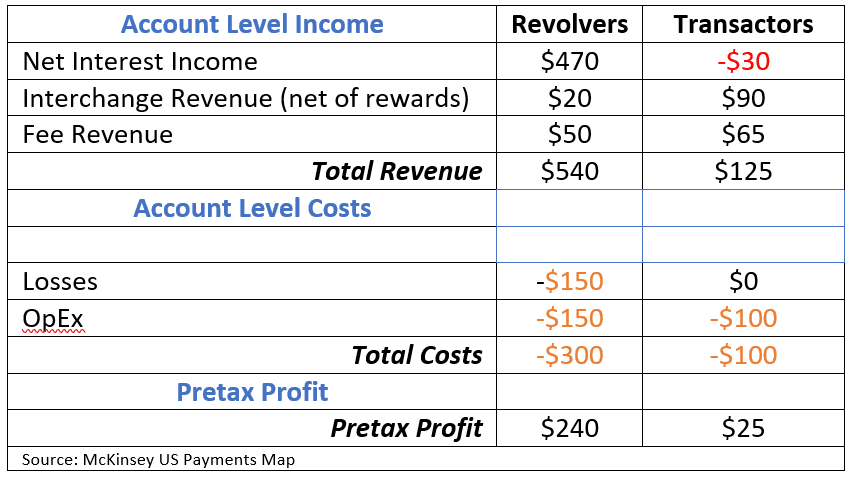
It will be interesting to watch these numbers change as the recession forms. Reduced consumer spending would decrease interchange revenue. Revolvers might increase, or the amount they carry over might increase, affecting net interest income. On top of this, if the CFPB takes action on credit card late fees, expect to see the Fee Revenue inch down.
Operational expense costs will increase as collection volumes swell, and losses, which today only amount to 1.82% of portfolio value and could easily double. If you remember, back in 2Q2010, the loss number hit an all-time high of 10.97%, positioning even the best-run credit card business in a pretax loss position.
But the best news of the day is on Bank Stress Tests, which the NYT reported. Win, lose, or draw, financial institutions are positioned strongly if (and when) the recessionary cycle takes hold.
Credit card issuers have enjoyed strong profitability in recent years, but the mix of revenue sources will become increasingly important if economic conditions weaken. Slower consumer spending could pressure interchange income, while higher revolving balances may boost interest revenue but also increase credit losses, collections costs, and regulatory scrutiny. Institutions that effectively balance lending risk, fee income, and customer engagement will be best positioned to navigate the next phase of the credit cycle. As history has shown, successful credit card portfolios are built not simply on growing balances, but on carefully managing risk throughout changing economic conditions.
Overview by Brian Riley, Director, Credit Advisory Service at Mercator Advisory Group